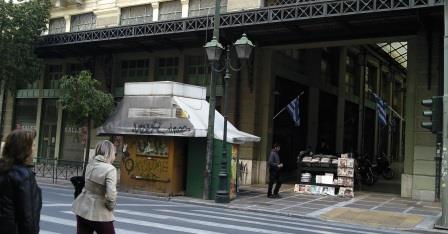
 The Slog: These pictures are of a main Athenian thoroughfare, Stadiou. Think
‘Tottenham Court Road’, and then imagine every kiosk, stall, shop and
indoor precinct closed down, every small shop empty and impossible to
rent, and the once-bustling pavements half empty.
The Slog: These pictures are of a main Athenian thoroughfare, Stadiou. Think
‘Tottenham Court Road’, and then imagine every kiosk, stall, shop and
indoor precinct closed down, every small shop empty and impossible to
rent, and the once-bustling pavements half empty.
These are all worthy topics for anyone still unclear about the catastrophic social effects of repayment-focused austerity in ClubMed. But if nobody buys in shops, eats in restaurants, sits in cafes or furnishes homes, businesses die in very short order.
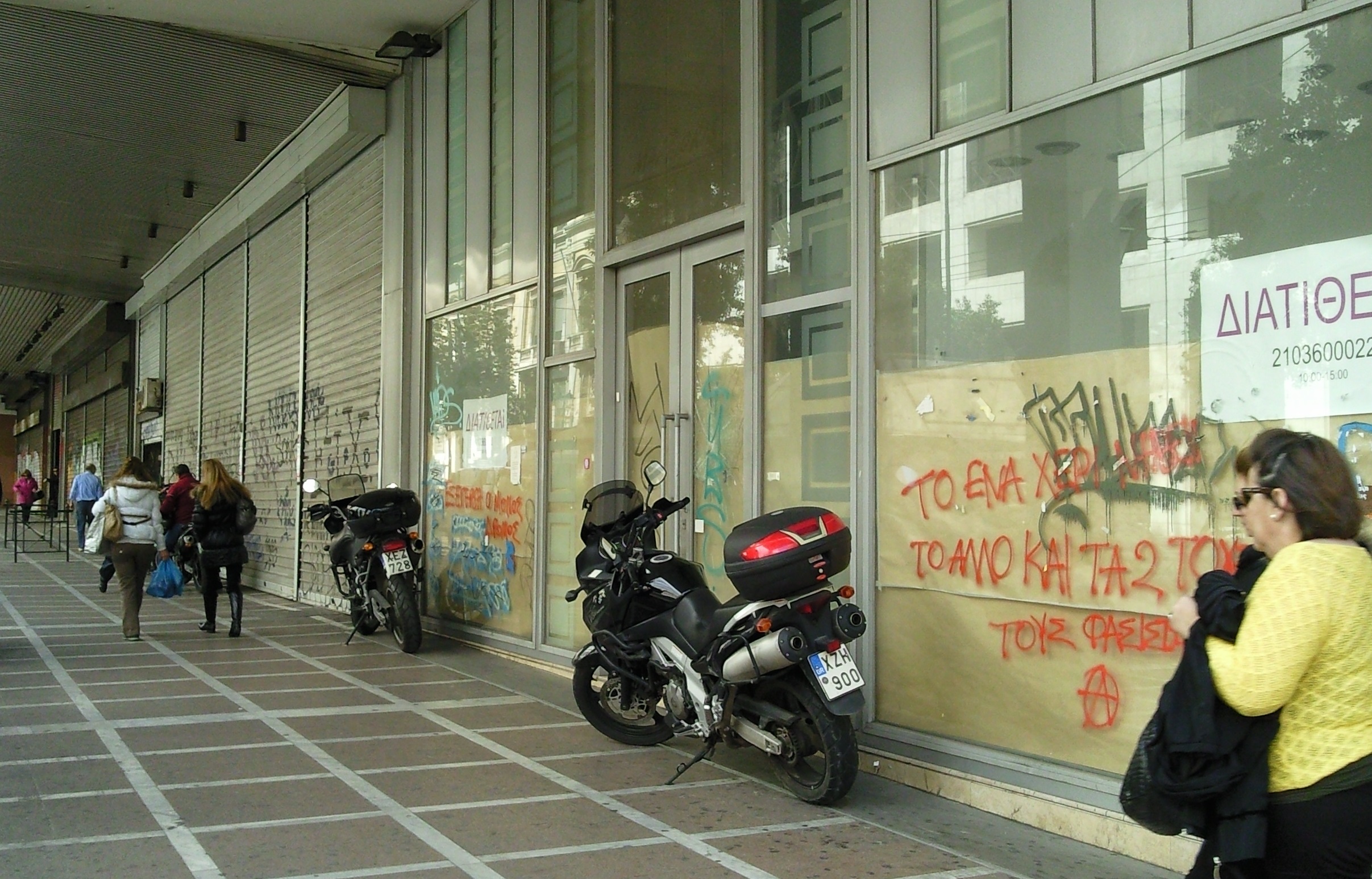
Behind much of Athens’ attraction as a tourist centre lies another layer of self-sustaining business: the wholesale trade. This above any other is small family business, where honesty, trust and quality are the basis of commerce. It too has been decimated, as both domestic and tourist consumption of goods plummeted after 2010.
 Everywhere are grills, graffiti, parked scooters, litter, and locks.
Nowhere is any business being done. An entire sector of the City’s
economy has been surgically removed. But nobody bothered to stitch up
the open wound afterwards.
Everywhere are grills, graffiti, parked scooters, litter, and locks.
Nowhere is any business being done. An entire sector of the City’s
economy has been surgically removed. But nobody bothered to stitch up
the open wound afterwards.What you can see in Athens is the death of independent small business competition, the desecration of families that depended on it, and the reassuring certainty for the fat cats that in future, where once there was community liberty and self-reliance, there will before too long be imported global goods produced by multinational companies, cheap property ready to be torn down by developers, and the State enjoying control over a demoralised population totally dependent on it.
 Some of the commercially naive bureaucrats and anthropologically
ignorant political ‘leaders’ behind this policy represent yet more
examples of what is wrong with European establishments throughout the
continent. But for others – the Stateists, the neocon social engineers,
the bourses, and the banks – all of this lost human energy is seen as
the logical (and desirable) consequence of driving the Great Global God
of Growth.
Some of the commercially naive bureaucrats and anthropologically
ignorant political ‘leaders’ behind this policy represent yet more
examples of what is wrong with European establishments throughout the
continent. But for others – the Stateists, the neocon social engineers,
the bourses, and the banks – all of this lost human energy is seen as
the logical (and desirable) consequence of driving the Great Global God
of Growth.In the vicious circle that is hard-sold debt >> government overspending and embezzlement >> high-tax austerity >> economic collapse >> social misery >> drastic political change, the Far Right is getting 1 vote in 8, and the Radical Left looks like having the largest number of Deputies after the next election. Both have reached these positions from having been tiny (<4 ago.="" parties="" span="" three="" years="">
But now at last, the focus is beginning to move away from corrupt old Parties and polemic ideologues towards a sort of patriotic pragmatism that no longer wants the euro. I spoke to several business people during my stay in Athens; most of them were not politically radical, but they recognised the need for a radical change to the economic model.
 “The austerity programme is counter-productive because it destroys
economic consumption in order to pay off State debt,” said a middle
manager in a larger foreign-owned Greek furniture business, “this is
like asking Berlin to pay off French municipal debt. It is resented, but
more importantly it is sacrificing recovery to the lenders’ needs. The
lenders may get their pound of flesh, but afterwards the patient is
paraplegic.”
“The austerity programme is counter-productive because it destroys
economic consumption in order to pay off State debt,” said a middle
manager in a larger foreign-owned Greek furniture business, “this is
like asking Berlin to pay off French municipal debt. It is resented, but
more importantly it is sacrificing recovery to the lenders’ needs. The
lenders may get their pound of flesh, but afterwards the patient is
paraplegic.”“The euro is the problem, no doubt,” said the co-owner of a medium-sized hitech business, “but if Greece were to go it alone and quit the euro, our business would be destroyed by a loss of credit confidence internationally. People like us want the euro to fail completely, so everyone will have to start again”.
His partner agreed. “The biggest problem we have right now is liquidity with which to expand, and credit so we can close deals with customers. Every week we work more and more to make less and less”.
 “These fantasies of the Troika,” one CEO of a rapidly-growing
political lobbying consultancy began, “they are all bullsh*t. The New
Democracy and Pasok go along with it because they are weak and corrupt.
But now things are far too serious for this to continue. The threats to
Greek business and national sovereignty will get worse as the lenders’
demands get more and more crazy. We have to elect commercial people now
who will gain public respect, and say “No” to the EU.”
“These fantasies of the Troika,” one CEO of a rapidly-growing
political lobbying consultancy began, “they are all bullsh*t. The New
Democracy and Pasok go along with it because they are weak and corrupt.
But now things are far too serious for this to continue. The threats to
Greek business and national sovereignty will get worse as the lenders’
demands get more and more crazy. We have to elect commercial people now
who will gain public respect, and say “No” to the EU.”Resentment towards the State sector and powerful bureaucrats is every bit as visceral as the disdain felt about the Troika.
Said one small entrepreneur, “These Troika people, so well dressed, such nice attache cases. They stay in the Hilton at Greece’s expense. None of them has any idea about business – only debt and repayment schedules. Now they insist that 150,000 civil servants be fired. Hah! That’ll be the day. Now they try to retire them off with fat pensions, but still they demand that the empty desks are filled with young recruits. They will cling onto our skin until we are all dead.”
There is a lot for the body politic to change here. The attitude to the euro, the weak resistance of Troika demands, fear of the bureaucrats, and the development of under-appreciated export businesses such as olive oil and wine. Nobody I met thinks the current crop of MPs is ever going to be capable of it. But there are endless scenarios in play as to how drastic change might come.
Of which, more later today.
Source

No comments:
Post a Comment