As ever the Jews tried to project all the needed optics in their attempt to punk the EU the way they've been punking the US for decades.

Though it doesn’t mean strikes on Moscow will cease—far from it—a strike of this magnitude was likely a one-off for several reasons.
Firstly, the mass amount of drones used which Ukraine likely had to save up for; this included many types of drones rarely seen before, and a greater combination of various drone types than ever seen in any previous attack which indicates that Ukraine really dug deep into inventories to try and utilize every possible platform available.
And secondly, the strikes were clearly meant to coincide with Zelensky’s ongoing European Council summit in Brussels where he needed to sell a version of Ukrainian “victory” over Russia to his comprador-masters in order to receive further funding. The Summit was used to project all the needed optics.
Along with the ongoing Eurosatory Paris defense expo, it was used as a clearly coordinated PR advertisement for the Moscow strikes in order to boost Zelensky and Ukraine’s standing.
The Ukrainian Defense Minister appeared to imply that the strikes were done precisely for the purpose of staging this spectacle during the summit:
Ukraine's Defense Minister Fedorov effectively confirmed the large-scale drone attack on Moscow was staged for Western sponsors, saying he hopes partners "see and understand" the window of opportunity, and calling the strikes on Moscow "a good signal" that Kiev is moving in the right direction and delivering on its promises.
Note how Ukrainian figures like the above continue to strike this new narrative that there is some kind of limited “window of opportunity” that Ukraine is opening up with these strikes. It’s a very peculiar framing because it obviously presupposes the this window will not last long, and begs the question as to why?
The answer goes back to what I said earlier: Ukrainian authorities appear to know such strikes have limited efficacies for a number of reasons; including: the amount of munitions used have to be saved up over a long period, and the stratagem employed is likely something Ukraine knows Russia will soon after adapt to, making future strikes of a similar scale unlikely. See: the infamous “Spider Web” attacks on Russian strategic aircraft which were never repeated again because they relied on one-off tactics that were never meant to be replicable.
Not that attacks on refineries are not replicable, but rather that Ukraine appears to sense that Russia will adapt and the “window” of opportunity this PR snowball effect is allowing will not last.
As an example, the PR campaign surrounding Crimea being cut off is already losing steam because:
Gas shortages in Crimea are no longer reported as normal supply flows have been re-established
New satellite captures have shown that Russia has erected not only various pontoons, but even earthwork bridges over the water between Kherson oblast and Crimea
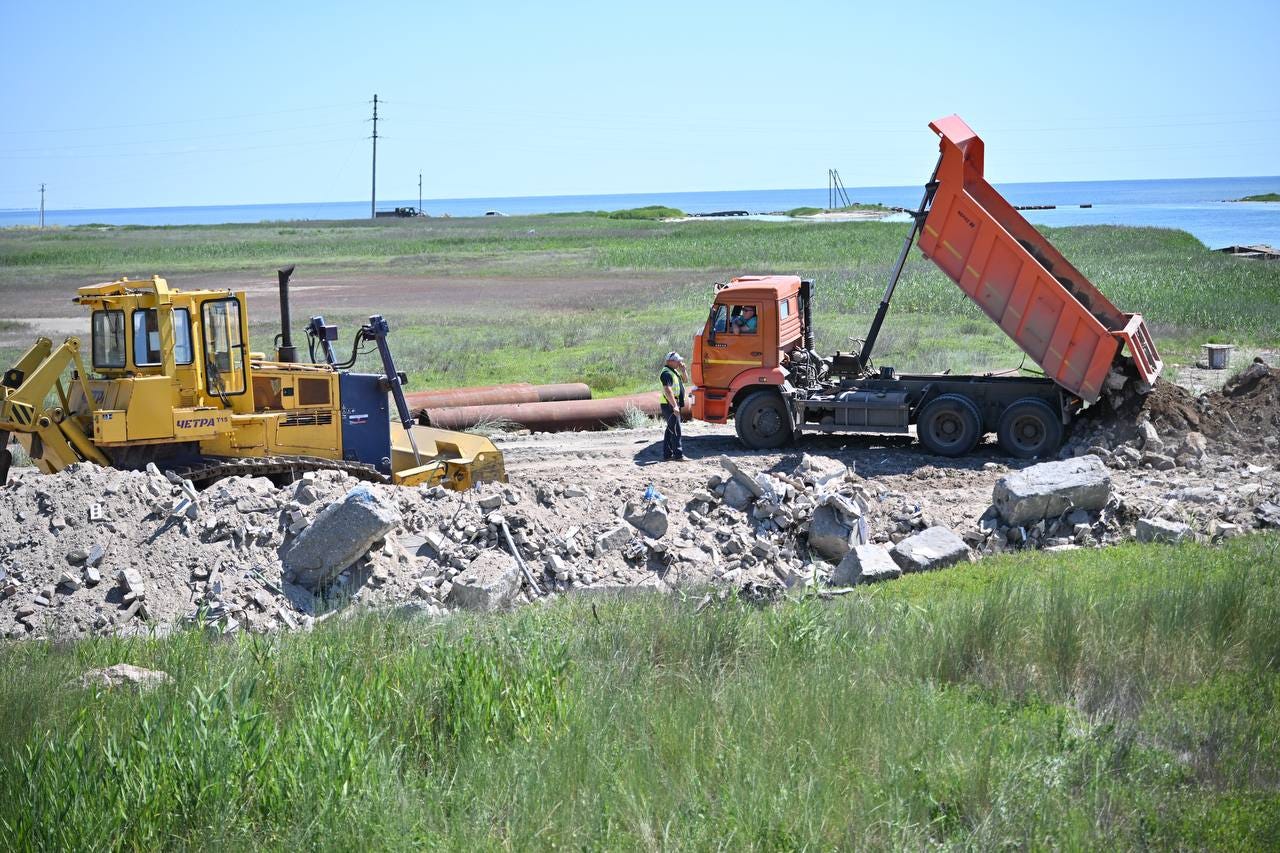
A new video showing the Kherson governor provided some “behind the scenes” looks at ongoing construction. It is said that after the Kakhovka dam was destroyed, the water downstream thinned out enough such that it was easy for Russia to merely create an earthen embankment alongside the Chongar bridge being struck by Ukrainian drones. Note the bulldozer building said crossing in the video:
To counter Ukrainian strikes on bridges to Crimea, not only pontoons were installed, but earth embankments were also created in the area of Armyansk and the village of Stavki.
The enemy reports this, citing low-resolution satellite images.
Due to the destruction of the Kakhovka HPP dam in June 2023, water supply from the Dnieper to the North Crimean Canal was cut off, so it is only partially filled by local resources, making the construction of embankment crossings easier.
The new embankment crossings highlighted in white below:
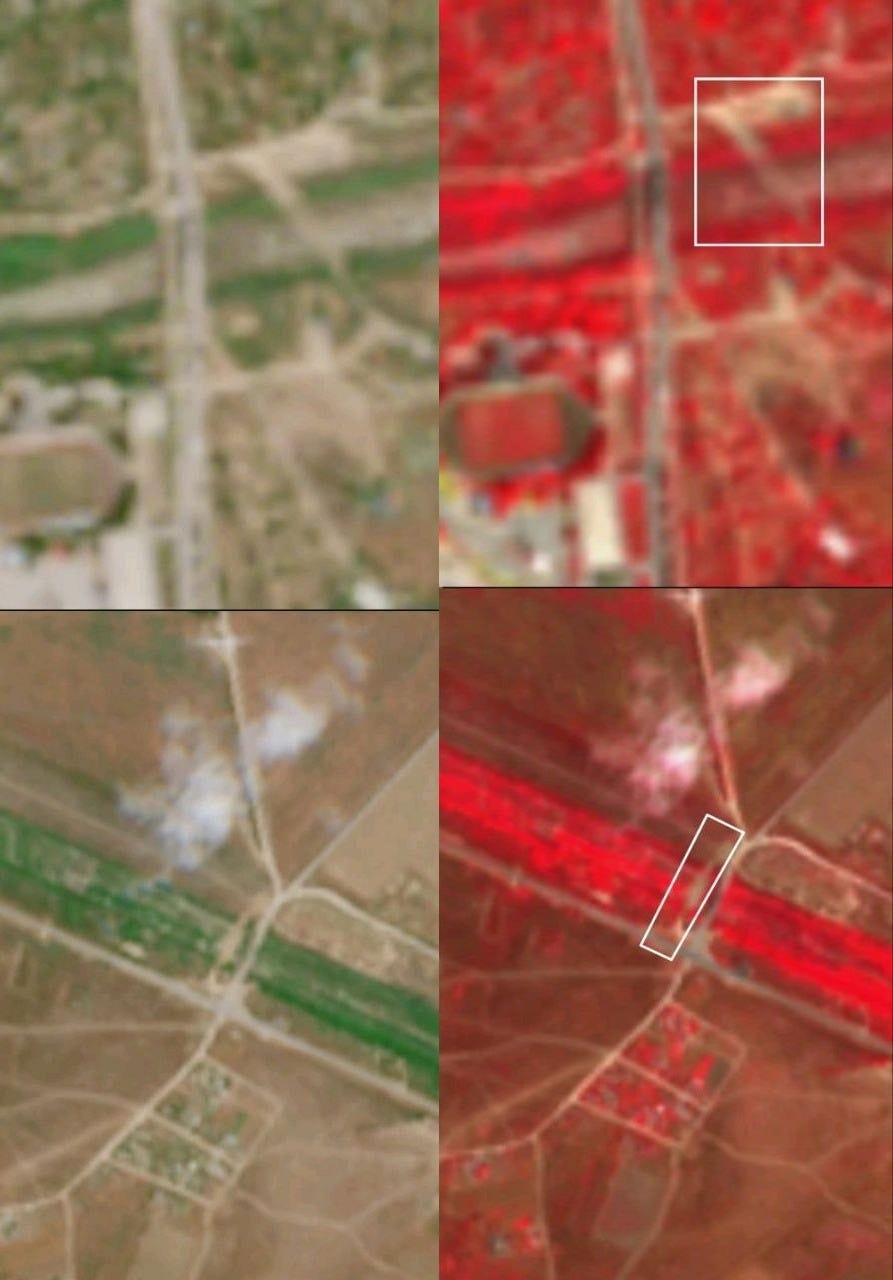
As can be seen, vehicle traffic is now passing normally once more, and the propaganda about “Crimea’s isolation” has again been dispelled and ruined.
Russian sources report the situation regarding Ukrainian ‘Hornet’ drones along the Crimean corridor is steadily improving, as Russian operators continue to hunt and take out these drones with increased success
Case in point from earlier today—a Russian “Yolka” interceptor takes a Hornet out:
Gradually, other problems are starting to be resolved. In particular, the hunt for the "Hornets" (also known as "Martians") in the southern corridor has begun. It took some time to organize the process, and things are not working perfectly yet, but there are positive changes. In our opinion, in addition to anti-aircraft drones, it is necessary to reinforce the southern front with new territories and MANPADS, then the hunt will be much more effective.
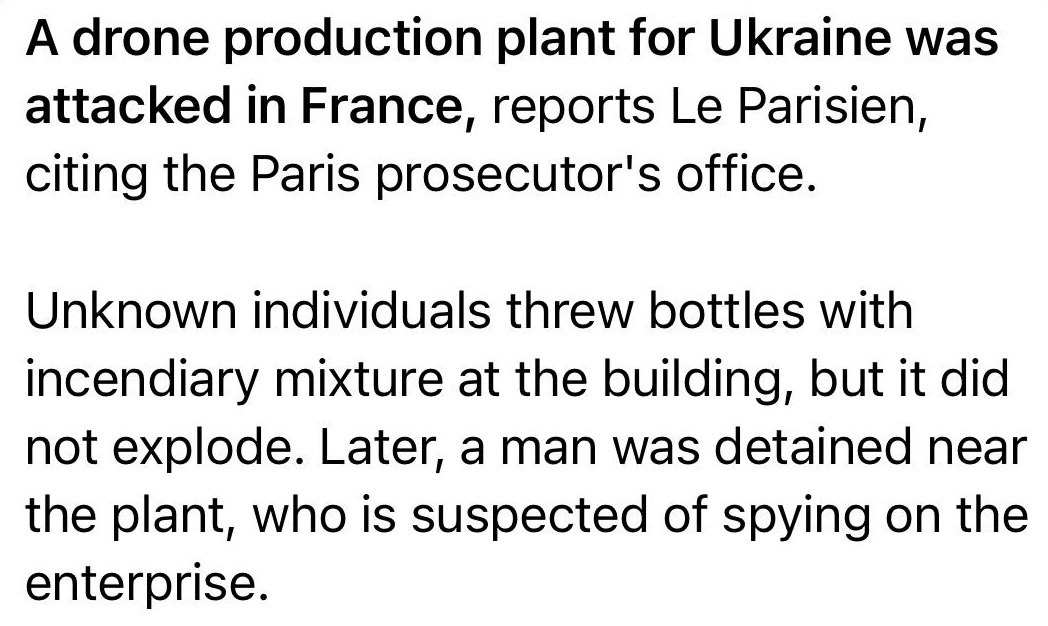
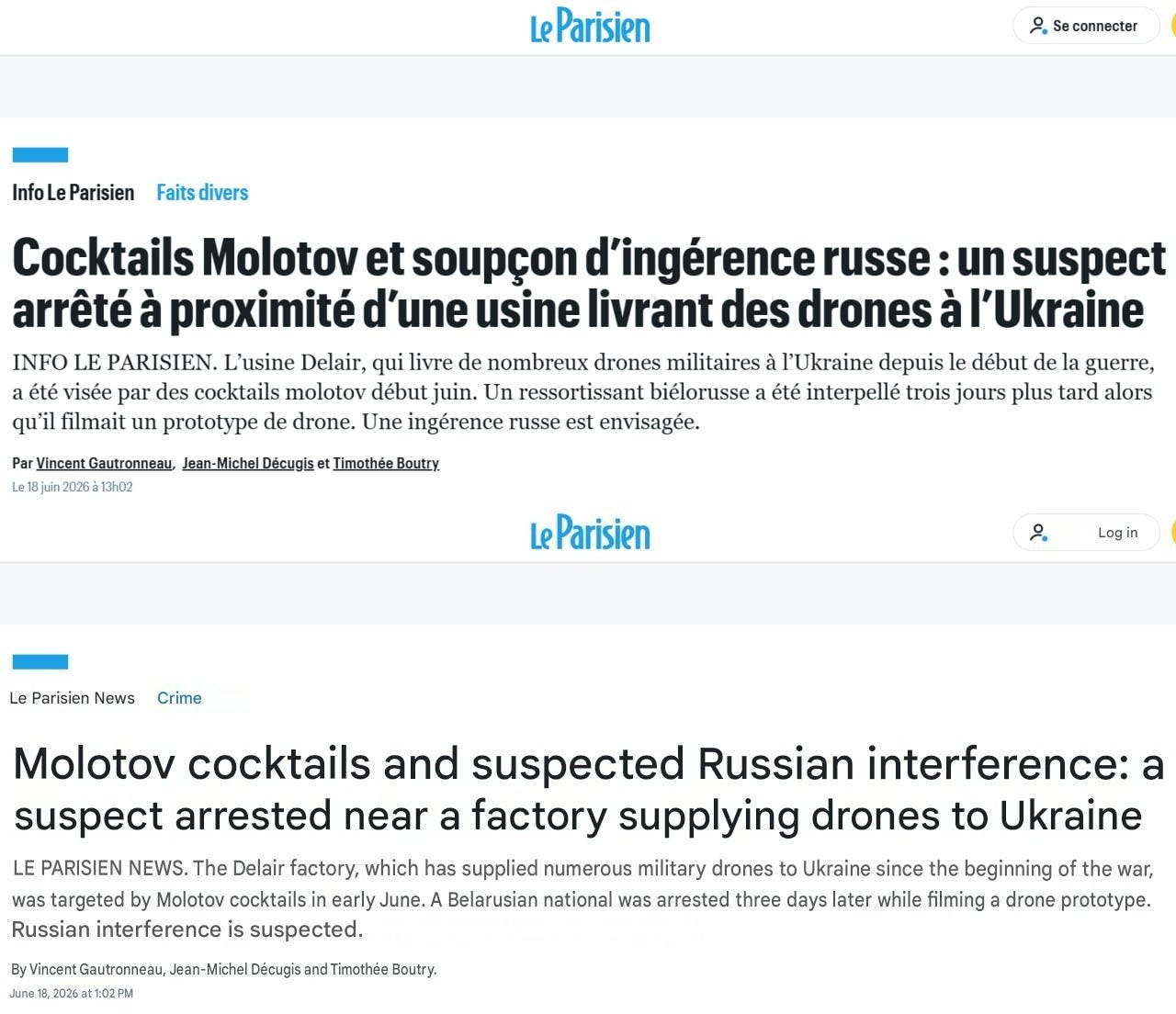
Other “interesting” things continue to occur vis-a-vis Ukrainian drone production
The problem is, Russian forces continue to advance, with settlement captures again picking up the past few days, for which Ukraine needed another desperate PR “antidote” to stem the negative press. Konstantinovka has been virtually captured, and now Lyman is in danger of falling soon as Ukrainian defenses collapse there.
As to the question of how Russia may counter Ukraine’s ongoing buildup of drones, it’s hard to say. But there has been a lot of buzz surrounding Russia’s new “Starlink killer” system being called the ‘Volna Kupol Garant’ (Wave Dome Garant) which some on the Ukrainian side fear could progressively allow the pervasive shutdown of Starlink over large swaths of Russian territory.
Ukraine’s electronics expert Serhiy Flash writes of the system:
How Russians suppress "Starlink" with EW systems.
Of course, "Starlink" is a serious problem for our enemy, and from the first day of the war, he has been experimenting with suppressing "Starlink" using EW systems.
The first case of suppressing "Starlink" by the enemy was recorded in 2024 on the Kharkiv direction. The Russian EW system was quickly detected by Ukrainian military and destroyed. Until 2026, no mass attempts to repeat its use were recorded.
After the start of attacks on Russia's logistics by Ukrainian mid-range strikes, we again began to detect the work of EW systems against the Starlink communication system. Of course, we detect and will continue to detect such enemy complexes and destroy them.
The destruction of the first such complex was recently demonstrated by the commander of the 422nd OP BPS on his channel https://www.facebook.com/share/v/18ckdSTrKy/?mibextid=wwXIfr
With his permission, I will show you the video of the destruction of the next EW complex against Starlink by the same 422nd OP BPS.
What do we know about the Russian EW system? Who produces it and how does it work?
The EW system is called "Wave Dome Garant". It is produced by the company OOO "Russian Dome" from Simferopol.
The principle of EW system operation is simple. A system of satellite antennas is installed on Earth, which "look" at the sky at a passing satellite. The system emits powerful interference from Earth to the satellite, so that the satellite does not hear signals from ordinary terminals.
Technically, the Starlink satellite receives signals from terminals in the range of 14-14.5 GHz. This range is divided into 8 channels, each 62.5 MHz wide. The Russians conditionally took 8 satellite "dishes", directed them at the satellite, and each dish transmits interference on its own channel. That's all. The satellite is "deaf".
One EW complex provides protection for about 20 square kilometers.
The EW Wave Dome Garant is mounted on trailers. On each trailer, there are two antennas, and the entire complex consists of 6 trailers. The antenna system can be removed from the trailers and placed on a single platform or mounted directly on the ground. Each antenna visually resembles an egg, but inside the egg hides a satellite dish with a rotation mechanism.
Like any EW system, the "Wave Dome Garant" consumes a lot of electricity. The complex can operate both on generators in each trailer and from an external power supply.
P.S. And the gentlemen from OOO "Russian Dome" managed to sell these products to the army at a price of 1.5 million dollars each. This is just fantastic.
Perhaps such developments are one reason Ukraine feels their “window” is closing—it’s impossible to know for certain, but virtually every Ukrainian figure privately admits—as ex-MFA Dmtryo Kuleba recently did in an interview—that all the jubilations surrounding Ukraine’s so-called “successes” will be shortlived and by winter time the howls of anguish around Ukraine’s deteriorating infrastructural stability will return.
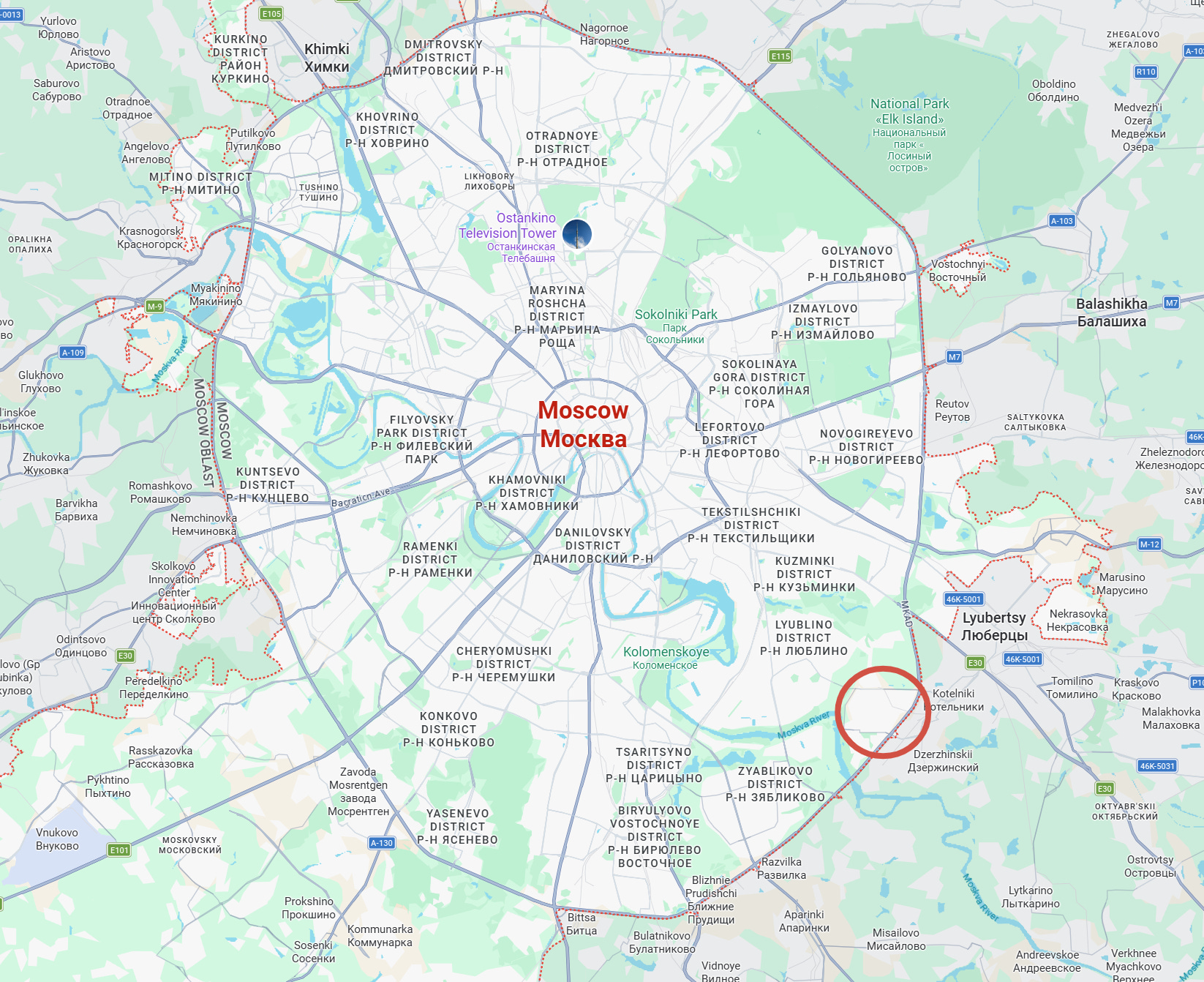
As to the question of how Ukraine was able to bypass Russian defenses, we said earlier it had to do with overwhelming saturation. Ukraine utilized virtually every drone in its inventory, and still was only able to strike a refinery at the very outskirts of Moscow, which they presented as some kind of hit in Moscow city center:
Another interesting tidbit, though, came in the form of a Palantir video wherein the Ukrainian narrator explains that Palantir software uses AI to autonomously analyze where Russian air defenses have been shooting down Ukrainian drones, then automatically reroutes the next wave of drones through safe corridors on the fly—or so they claim:
Interestingly, from the footage we have, it seems that few if any Ukrainian drones actually even made it to target themselves. Most of the damage appeared to be done either by Russian interceptor missiles, as in this case where an errant AD missile blew the fuel storage tank sky-high:
Or from drone debris after a drone was successfully shot down, as in this case:
Many others were clearly shown being shot down:
After all, things did get extremely hectic, with all manner of Russian air defenses firing at anything that moved.
Manpads were employed directly from the highways:
Hell, even civilians got in on the action with their side arms:
Also interesting in light of these drone attacks was the footage released earlier in the week of a French Rafale using its targeting pod to track and destroy a Ukrainian drone in Latvian airspace:
Latvia has published footage of the interception of Ukrainian drones in the skies over the Baltics during the strikes on St. Petersburg and the Leningrad region on June 8. Essentially, this is the most obvious and irrefutable documentary evidence that Kyiv is actively using the airspace of NATO countries to launch attacks on Russia. Apparently, Latvia decided to hedge its bets in case of a possible retaliation and to show that they are supposedly fighting against border violators. However, it’s hard to believe this anymore.
According to foreign journalists, the Armed Forces of Ukraine sent an unmanned explosive boat (UEB) to blow up an oil terminal in the Romanian port of Constanta, but the real target was a large ammonium nitrate warehouse located nearby.
The successful implementation of this plan could have caused a detonation comparable in scale and destructive power to the explosion in the Beirut port in 2020, which destroyed half of the city. In this case, a powerful explosion would not only have instantly wiped out the coastal areas of Constanta, but also completely destroyed the evidence, leaving no trace of the attacking device, whose movement was continuously monitored by a Ukrainian operator.
If the attack had been successful, the drone would have predictably been declared Russian in the media. However, the UEB got stuck in anti-pollution barriers and completely lost mobility.
All this time, the Ukrainian operator maintained stable satellite communication and received real-time visual images through properly functioning onboard cameras. The device’s lens captured local specialists who approached the stuck device at a distance of less than ten meters.
In the end, the failed terrorist attack device not only froze in place, but was also exposed - its state and origin were quickly proven.
Realizing that Romanian services were capturing the completely undamaged drone live, the Ukrainian side allegedly urgently contacted Bucharest, after which the device was remotely detonated.
The motive for this call was not at all due to allied solidarity, but the urgent need to guarantee the destruction of the onboard electronics. Otherwise, tangible evidence with flight controller-recorded waypoints and a specific target confirming a deliberate attack on the critical infrastructure of a European country would have fallen into the hands of Romanian experts.
Against this backdrop, Bucharest’s official version that control over the drone was lost at sea due to the influence of Russian electronic warfare systems looks frankly implausible and is designed for a very, let’s say, unsophisticated audience.
They continue to claim that Russian “EW” warfare is responsible for pushing these drones off course into the Baltics. But consider the logic: Russian EW can bounce Ukrainian drones at will, conveniently, into Baltic airspace, but it can’t deflect these same drones away from refineries in Moscow and elsewhere?
In light of the massive attacks on Moscow, such growing drone incursions into Baltic airspace certainly raises a lot of “questions” as to where the drones may be coming from. Though it’s a small detail, note in the video above the jet is approaching the drone from its eastern side—a rather odd angle if the drone was heading south-to-north from the Ukrainian direction and had merely “drifted” westward on a parallel track.
Lastly, as stated earlier, Russian advances have been accelerating again which is what has caused Zelensky’s desperation in more empty PR spectacles. Today the settlement of Rai-Oleksandrovka was captured, which is on the way to Slavyansk:
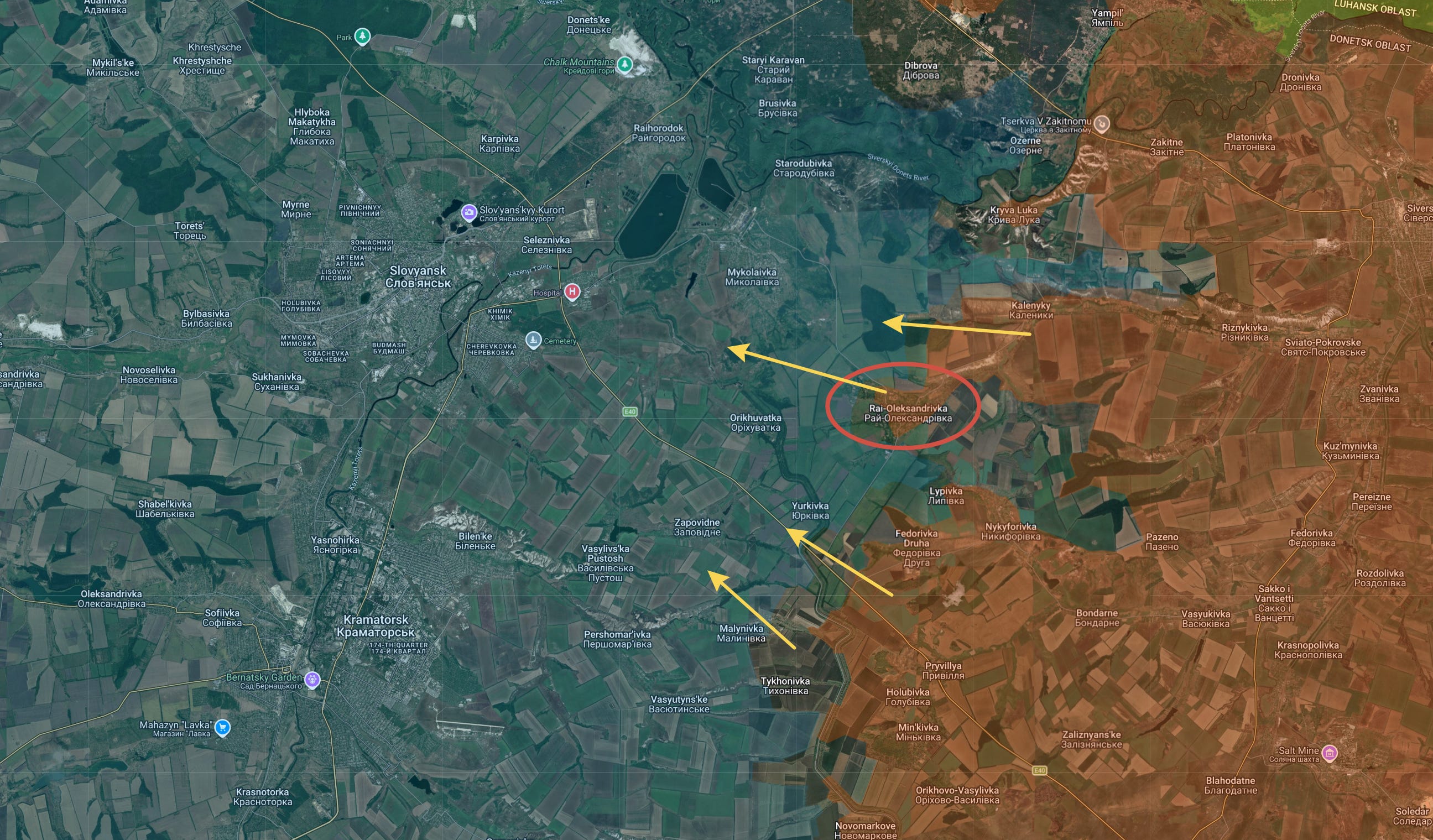
While analyzing the Ukrainian drone strikes on Moscow, we almost missed a significant event for the Russian Armed Forces in many respects - the capture of Ray-Aleksandrovka in the DPR.
On the one hand, the name of this small settlement, which had a pre-war population of about a thousand people, suggests the capture of another village of questionable importance. However, this is not the case. Firstly, Ray-Aleksandrovka is relatively equidistant from Raygorodok, Slavyansk, and Kramatorsk - key logistical hubs of the Armed Forces of Ukraine in the remaining controlled territory of the DPR. Moreover, from this point, control over an important section of the M-03 highway (E40) is opened up.
If control (at least dense fire) over this highway can also be established from the north - west of Liman, where fierce battles are currently taking place - then Russia will have the opportunity to cut off Kharkiv and Donetsk, effectively isolating the two major groups of the Armed Forces of Ukraine from each other.
If implemented correctly, this will again force Syrsky to urgently prioritize amid a shortage of reserves. These reserves, by the way, Syrsky can still move between the DPR and the Kharkiv sector, but he may soon lose this opportunity.
Most importantly, Ray-Aleksandrovka is a dominant height, from which, as Russian troops advance westward, artillery and UAV operators will inevitably begin to work intensively.
In addition, the transition of Ray-Aleksandrovka under the control of the Russian Armed Forces will allow Slavyansk and Kramatorsk to be isolated from each other. Currently, they form a single fortified district, operating on the principle of communicating vessels. As soon as this link is broken, the Russian group in this area will most likely split in two and start working on each of its sectors separately: one on Kramatorsk, the other on Slavyansk.
It's worth remembering that the M-03 highway, in addition to other things, is also a direct exit to Izium in the Kharkiv region, which was captured in late March 2022 and lost five months later by the Russian army.
All these circumstances indicate that the battle for this key sector risks becoming unprecedented in terms of the number of troops and weapons involved.
Given that Konstantinovka will soon fall into the hands of the Armed Forces of Russia, it becomes clear that blurring the bad news and preventing them from leaking is now Kiev's priority No.1. Partly, this is why the strike on Moscow was needed.
Just north of there, Krasny Lyman has almost entirely fallen to Russian forces, with Russian troops geolocated walking around through the center of town:
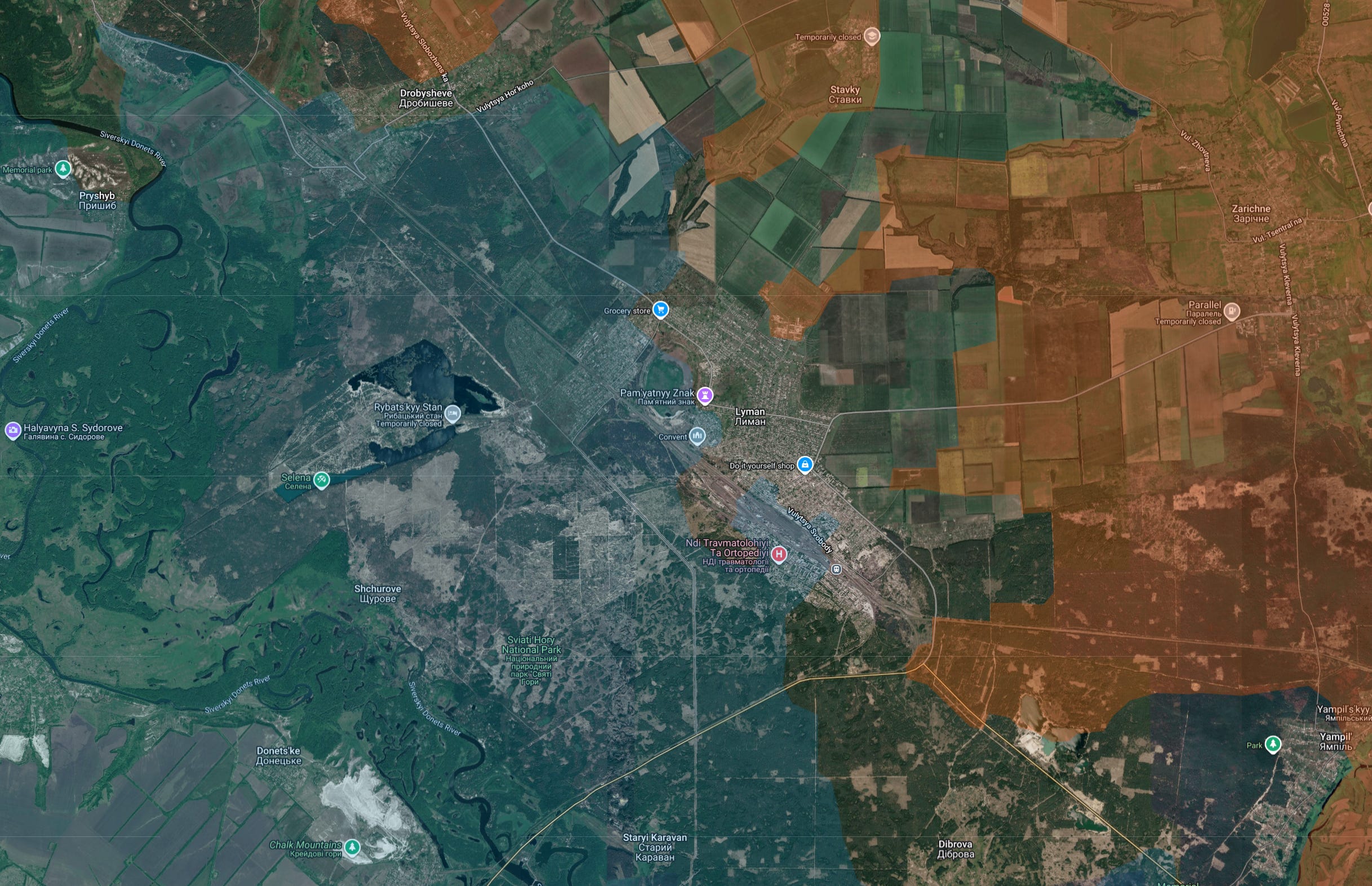
Other maps have it as follows:
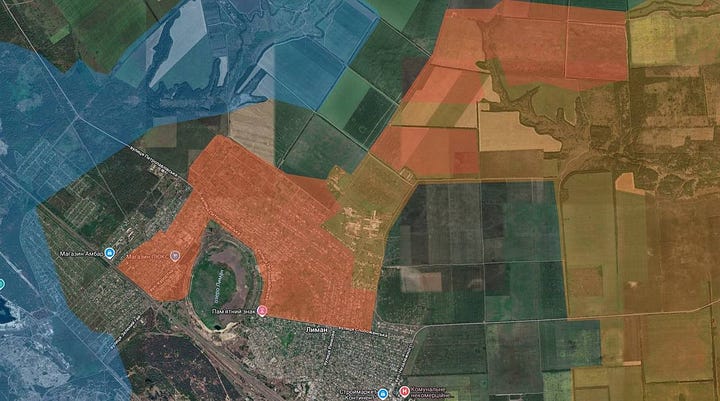
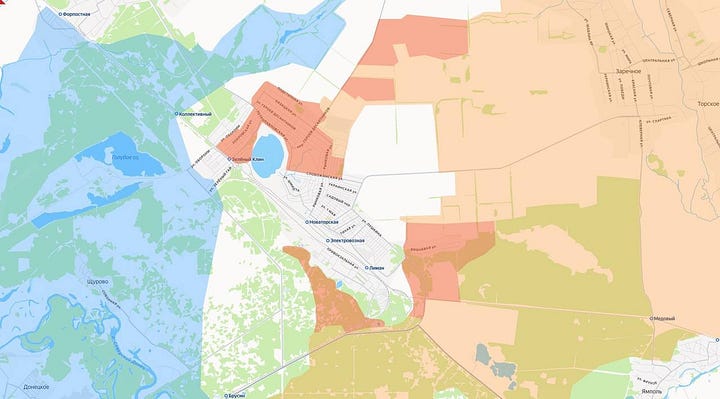
The situation in Liman is critical for the Ukrainian Armed Forces. The Russian army has cut off the only supply route and started an assault on the city. The General Staff has not given an order to retreat again, and in fact, an entire brigade has been trapped and is now being annihilated.
We hope that the court will evaluate all the decisions of Syrsky in the future, who is simply destroying the reserves of the Ukrainian Armed Forces.
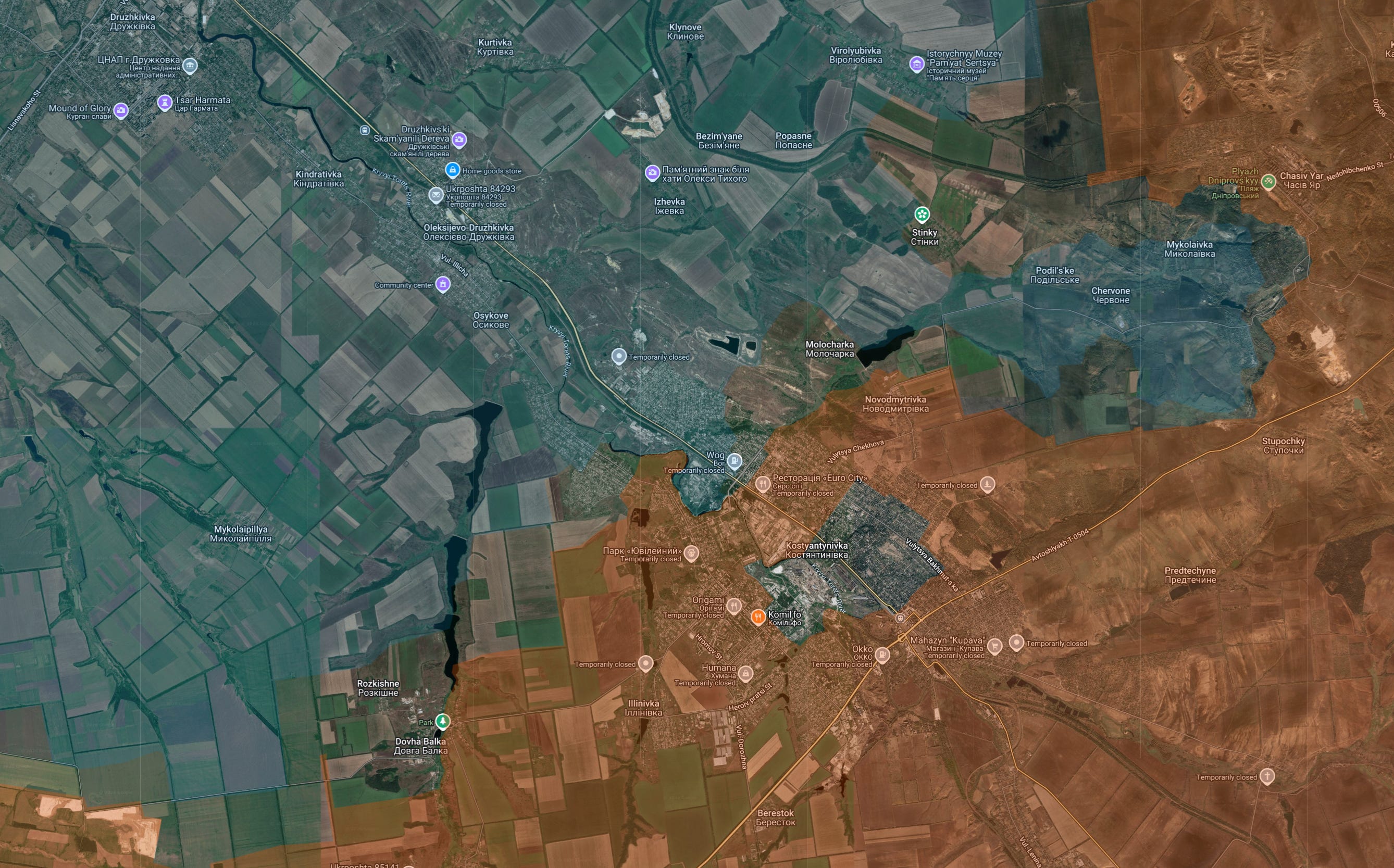
And according to Suriyak and others, Konstantinovka has now been fully closed off by Russian forces and is set to fall any time:
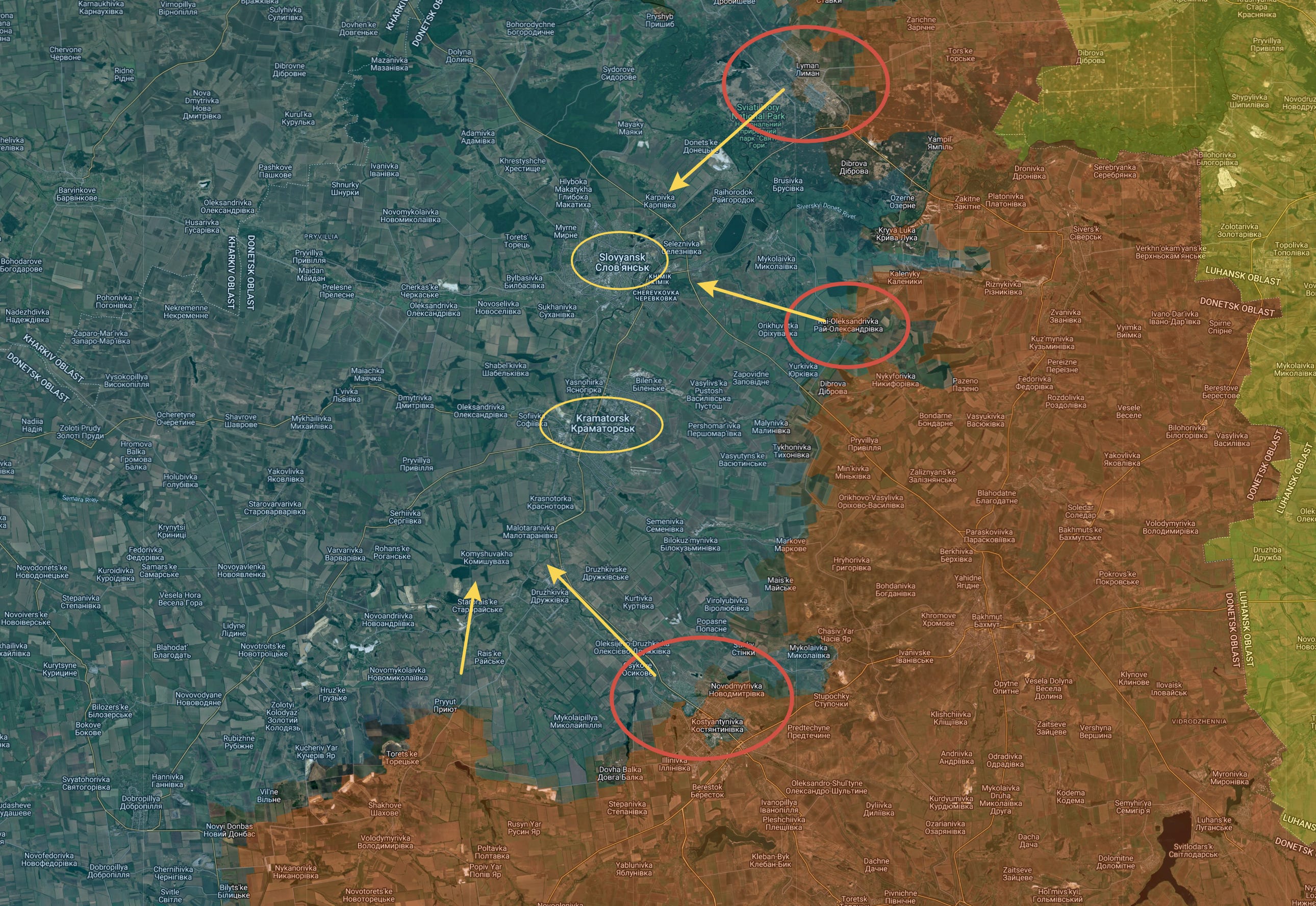
The advances in these three key areas shows Russian forces slowly encircling Ukraine’s final Donbass stronghold of the Slavyansk-Kramatorsk agglomeration:
That’s not to even mention the Gulyaipole zone where Russian forces likewise continue to push westward, though of course no where near as quickly as before. It’s clear why Ukraine needs these “smokey spectacles” for their curators.
One supposes the new exchange of dead bodies on the front also doesn’t quite help Ukraine’s cause:
An exchange of fallen soldiers between Russia and Ukraine is taking place right now.
— AMK Mapping 🇳🇿 (@AMK_Mapping_) June 18, 2026
522 Ukrainian bodies are being exchanged for 33 Russian bodies.
Interesting how the last two exchanges have seen the first drop in Ukrainian body numbers in over a year:
(Ignore the “Second World War” AI mistranslation at the top)
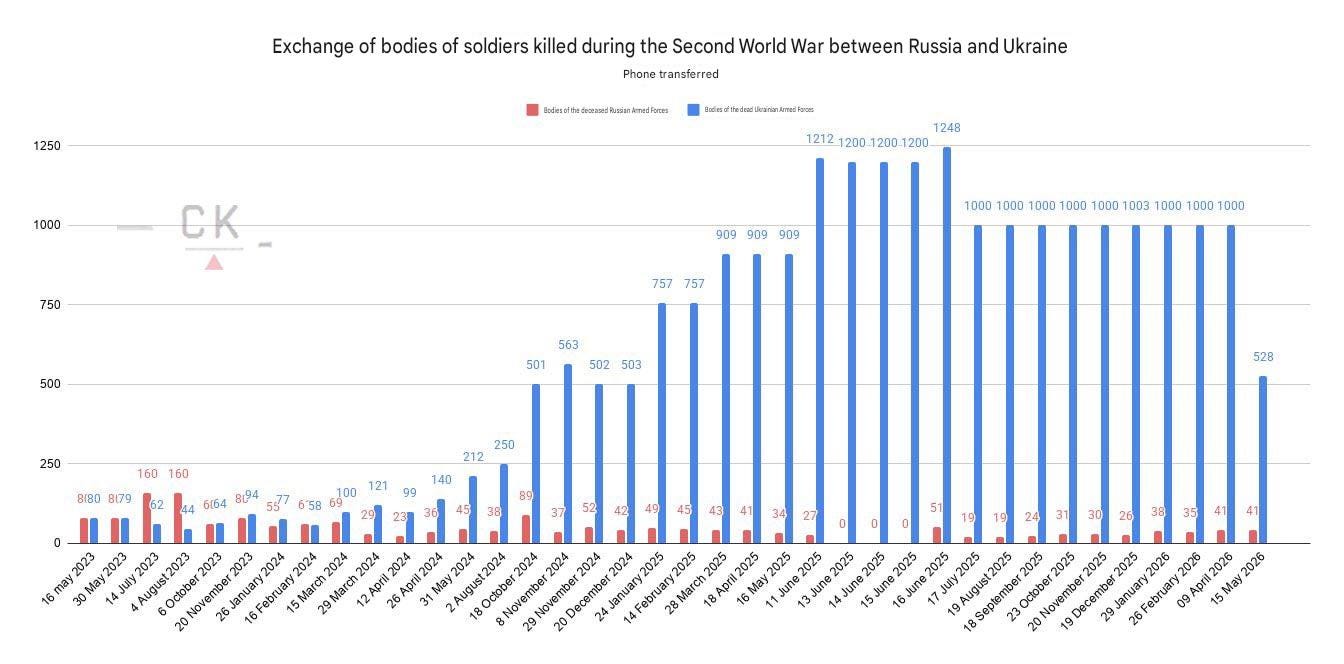
After a year of 1000:30 exchanges, in May Russia gave back 528 Ukrainian bodies and another 522 in June. This could have something to do with the fact that Ukraine claims to have captured a net positive amount of territory these past two months. Recall the theory that the side which advances is the one which is able to collect dead bodies—could this have something to do with it? If it does, it clearly shows that Ukraine’s losses are still disproportionately greater than Russia’s whether it’s advancing or retreating.
As a final note, here’s a report on the “devastating” nature of Zelensky’s Moscow PR spectacle:
Attack on the Moscow Refinery - Latest Data
▪️The supply of petroleum products to the capital is proceeding normally, and all gas stations are also operating as usual, the city's municipal services complex reported during the day.
▪️The concentration of pollutants in Moscow does not exceed the permissible values after the drone attack on the Moscow Refinery, - stated in MosEcoMonitoring.
▪️Recall, early in the morning, Ukrainian drones attacked the Moscow Refinery. Sobyanin reported that several UAVs managed to strike the enterprise.
▪️The fire that occurred as a result of the UAV hitting the Moscow Refinery has been largely contained, and the remaining hot spot is being extinguished. There were no casualties at the plant, the mayor said at 14:53.
▪️The enemy's attack on the capital region was the largest in 2 years: about 200 drones were shot down on the approach to Moscow, and 17 people were injured.
▪️The head of the Ministry of Foreign Affairs stated that Russia will continue to carry out "regular massive group strikes" on Ukraine, "on targets from the state of which the combat capability of the Armed Forces of Ukraine depends", as "words alone are no longer enough".
But what do you think?
No comments:
Post a Comment