'The US has very few cards, and it is for the Americans—and particularly Trump’s political career—that time is ticking.'
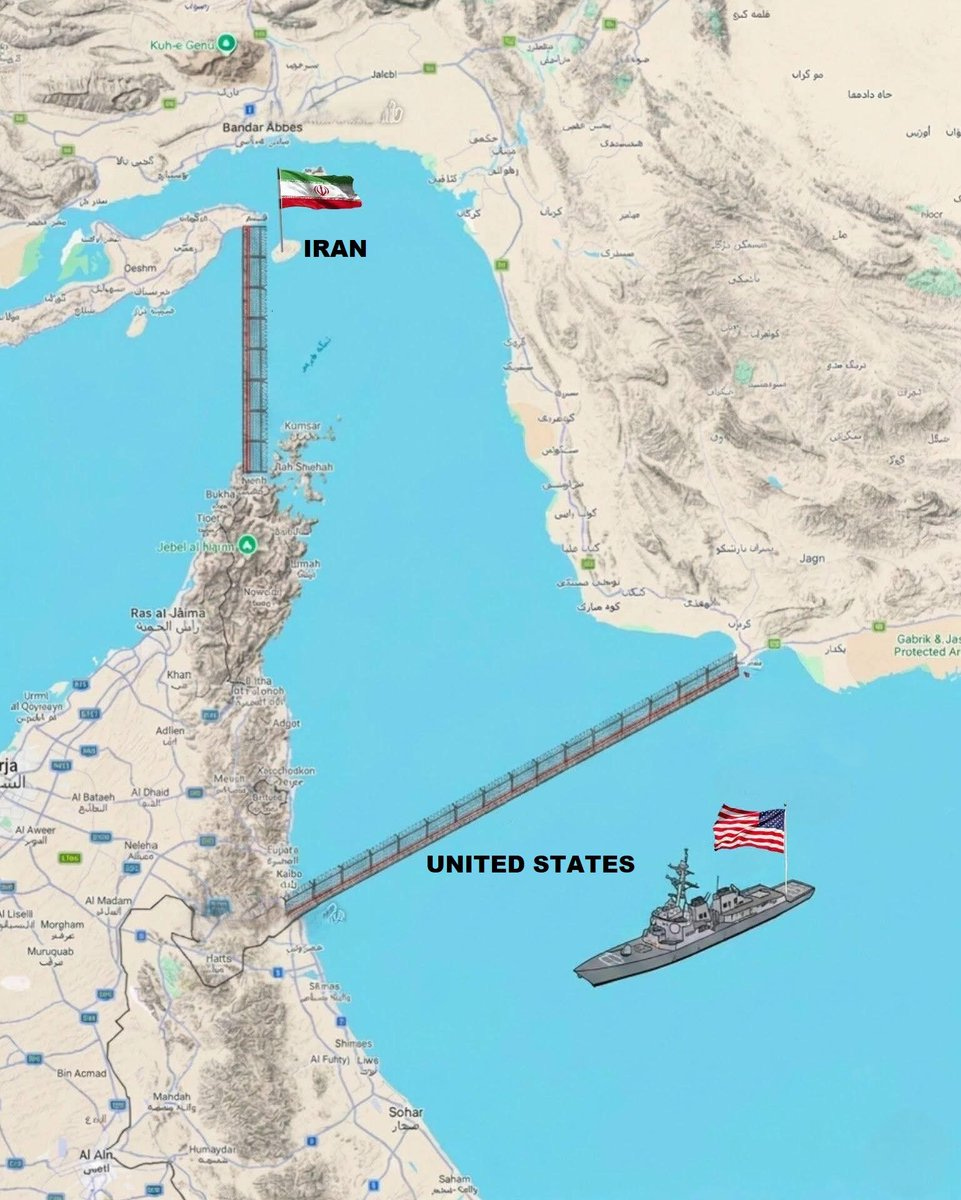
By Simplicius: Yesterday Trump’s “blockade” went into effect, with an alleged 16 US warships attempting to enforce it somewhere outside the Strait of Hormuz. This has led to a wide array of speculation on what exactly is happening, and how much fact vs. fiction there is in Trump’s ambitious claims.
AP confirmed that not a single US warship was in the Persian Gulf:
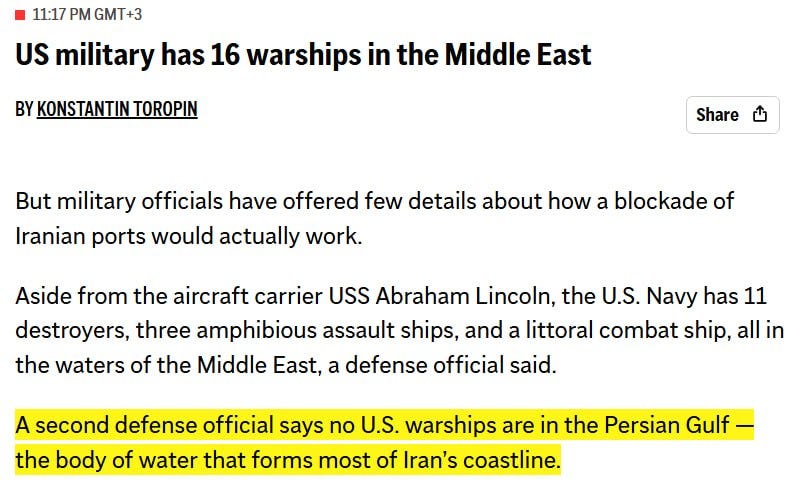
Associated Press :- America has only 16 warships in the region and no warships in Iran’s territorial waters, which make up most of Iran’s waterways.
- This indicates that the ability to blockade Iran’s ports with such a small number of ships is very weak.
As hinted earlier, there is a rash of clashing reports. The US touts its success while MSM channels have revealed that many tankers carrying Iranian oil are sauntering through the Strait unmolested:
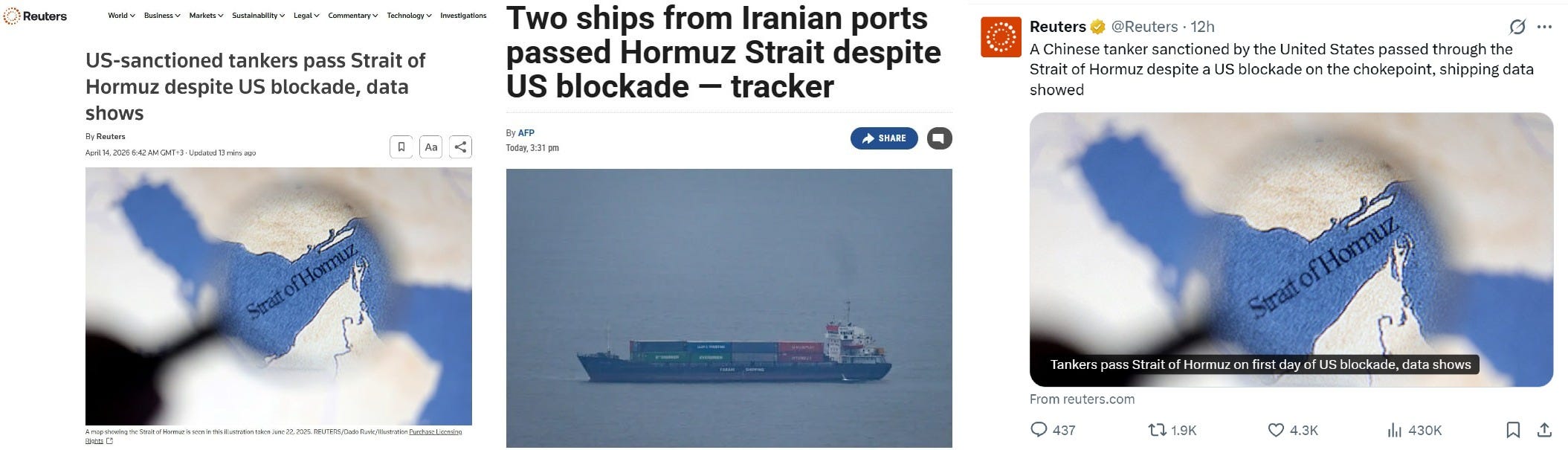
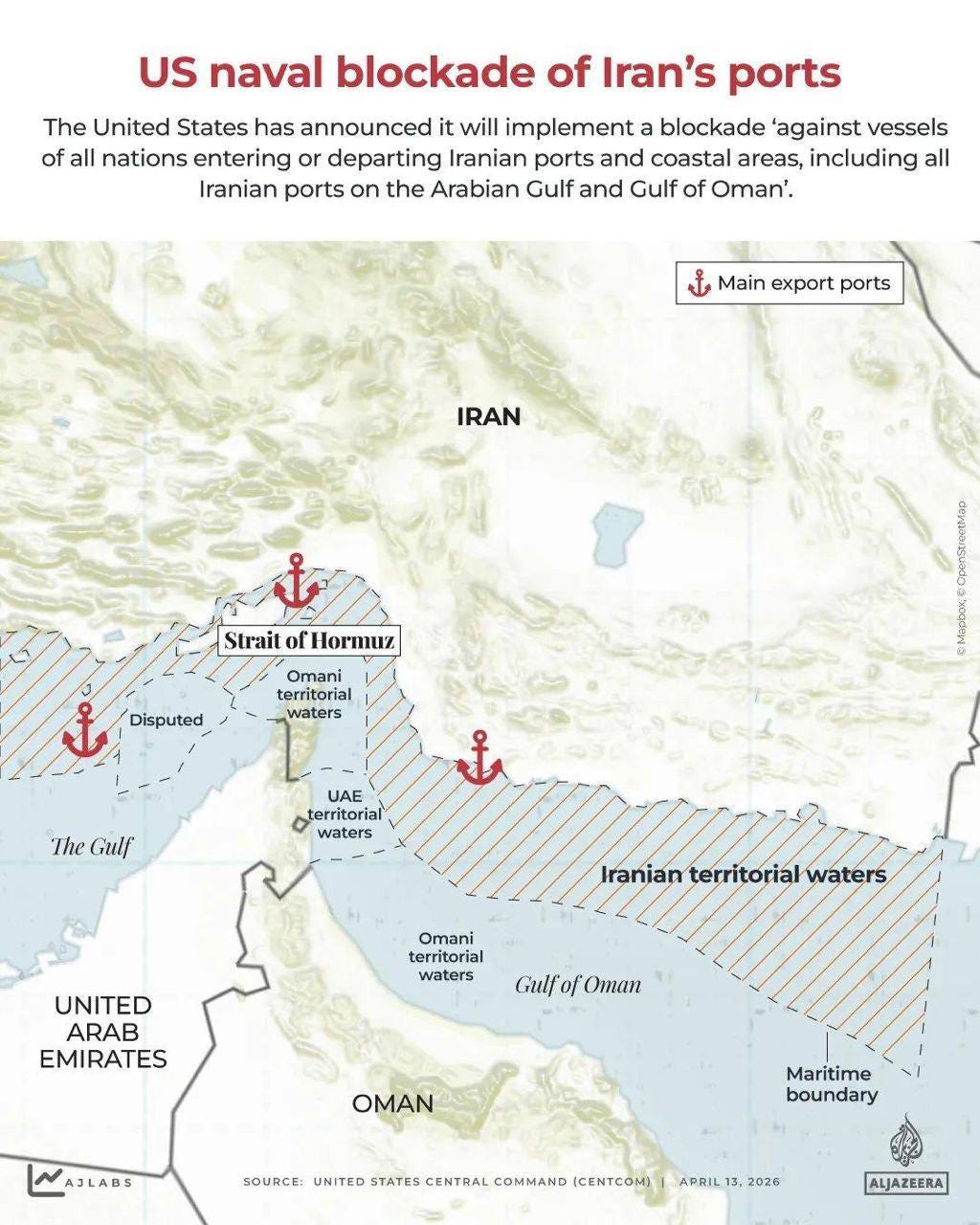
Ships linked to Iran are passing through the Strait of Hormuz, but the US blockade prevents them from entering the Gulf of Oman, — Marine Traffic
▪️The ships are turning back, monitoring resources report.
▪️It was previously reported that 4 Iranian ships passed through the Strait of Hormuz, despite the declared US blockade.
This could be a case of “semantics”. The US, of course, doesn’t control the Strait itself, but is rather attempting to interdict traffic far outside, in the Sea of Oman. Anti-Trump MSM naturally seeks to ridicule the US’s failures at every turn. Some might think we here are doing the same thing as many recent articles have had a decidedly anti-Trumpian slant, but that is not the case. We will always report the facts no matter whom they flatter or deprecate, as we have no horse in the race here.
That said, Trump has continued to baffle the world with his erratic and nonsensical double-dealing. Literally hours after launching his own “blockade”, he boasted that a record number of ships had actually transited through the Strait.
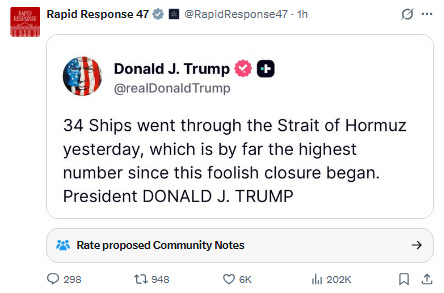
Bragging about one’s own blockade being ineffective? Someone, explain that one.
That’s not long after he again claimed that Iran’s navy is completely destroyed, except for that one other second navy that is in fact not destroyed because it didn’t “pose a threat”:
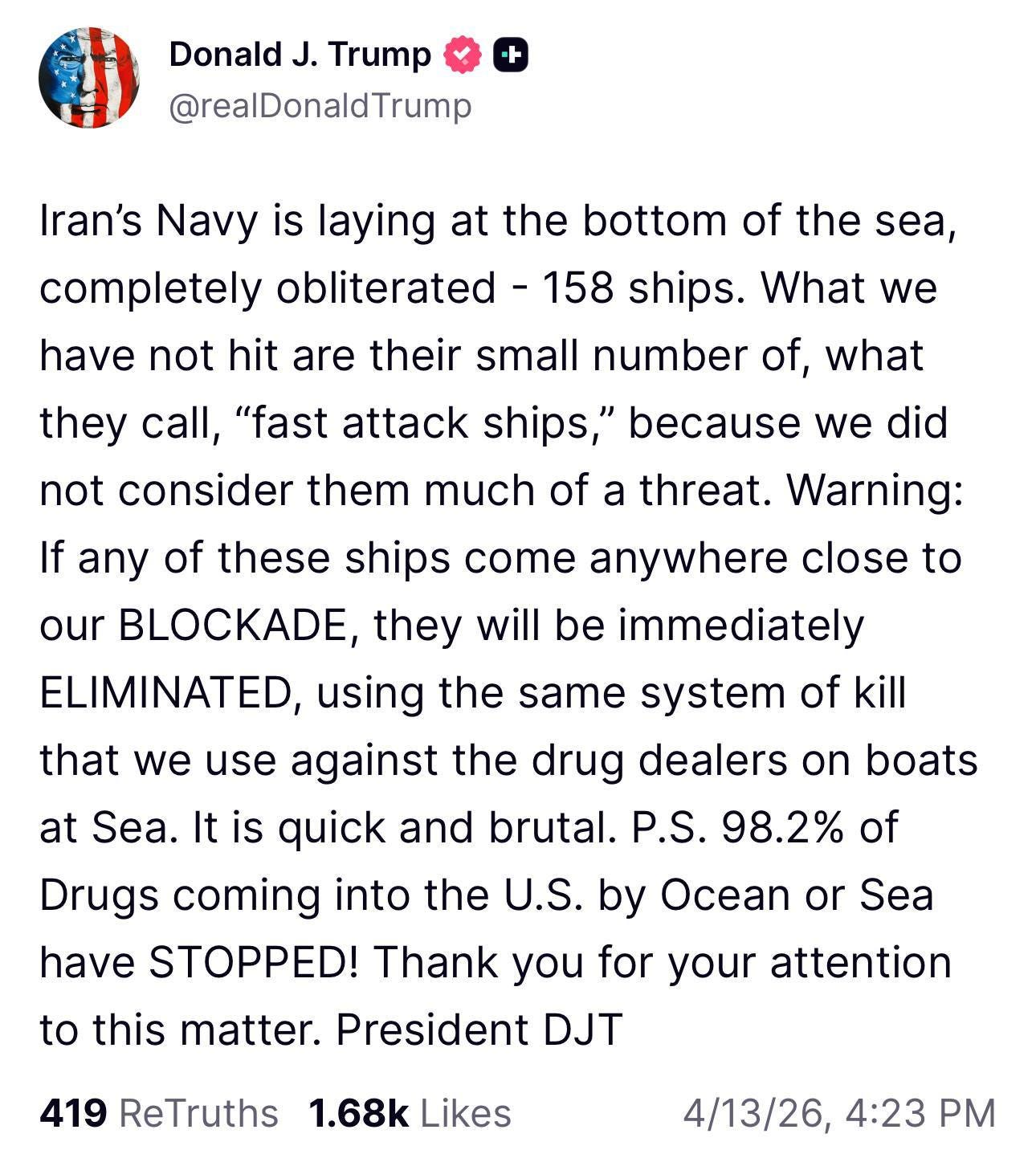
His claims of “instantly destroying” any Iranian fast attack boat that comes close to US ships appear to have been contradicted a day earlier when a video—posted in the last update—showed an Iranian fast attack boat boldly doing just that.
Insiders tell the same story over and over: low-impulse-control, short-term-thinking Trump is addicted to the “quick fix”, dopamine bumps he can put up on the score board for insta-PR-boosting headlines—the way the masterfully constructed Venezuelan theatrical performance did. (How’s that Venezuelan oil doing, anyway? We haven’t heard much about it recently.)
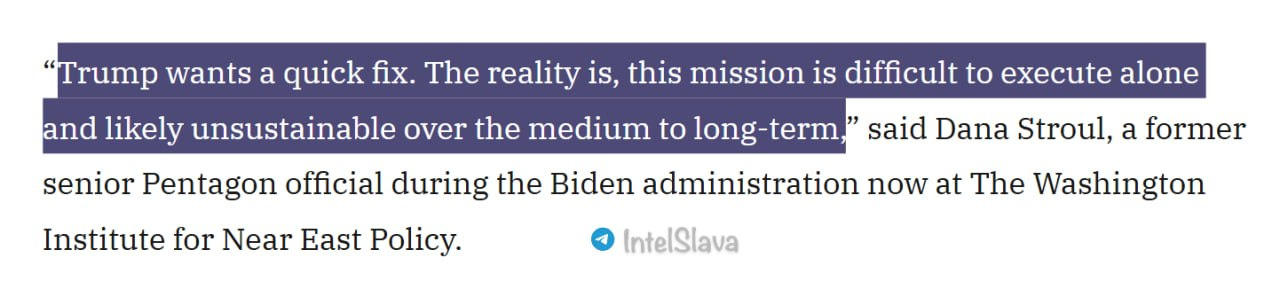
Getting back, it appears the US Navy has slowly been slinking toward the Sea of Oman in order to attempt interdicting Strait of Hormuz traffic, with Trump opportunistically claiming the Strait is either both open or blockaded as per his daily whim, or which way he gauges the headline winds are blowing.
The USS Lincoln was reportedly spotted now only 200-300km away from Iranian shores near Chabahar port in the Sea of Oman:
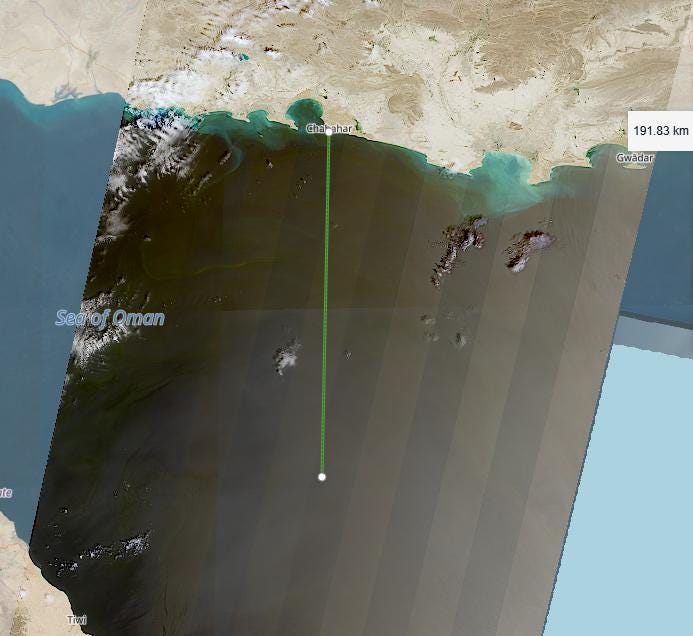
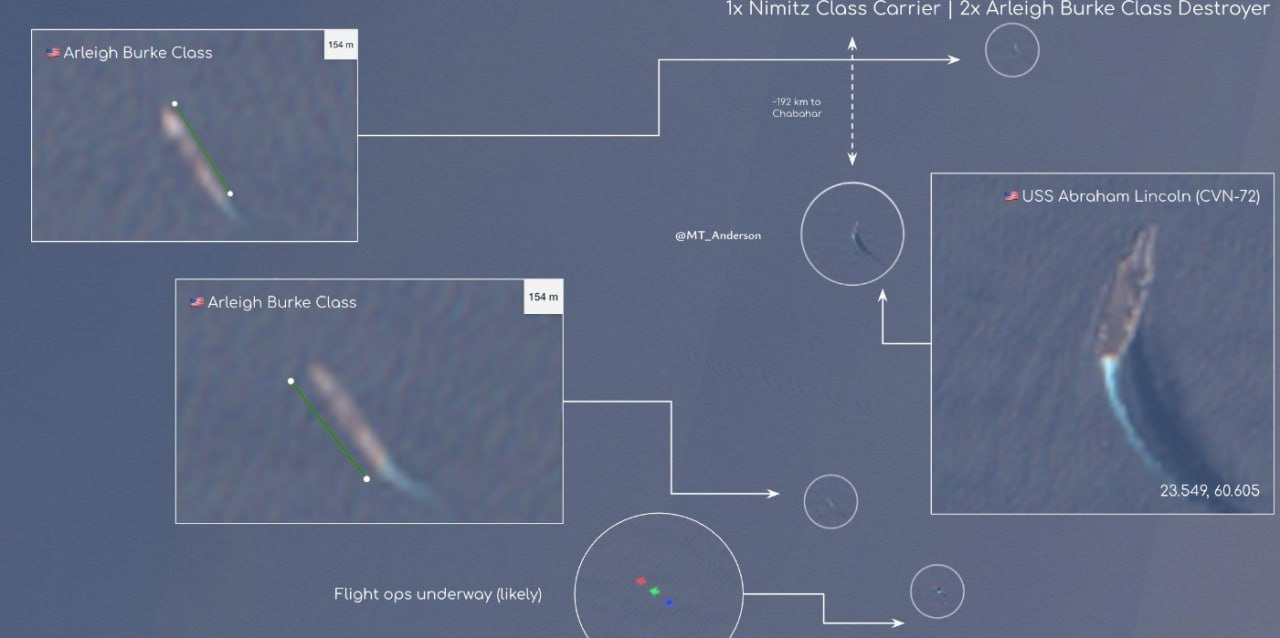
The approximate distance at which the American aircraft carrier USS Abraham Lincoln (CVN-72) is currently located from the coast of Iran is around 250-300 kilometers. It’s noticeable that the US Navy has for some reason decided to risk the ship, the total cost of which, together with its air wing, is approximately 12-14 billion dollars. The basis for such confidence is not entirely clear, as Iran still has a significant reserve of anti-ship missiles. It seems that the US Navy command is confident that the IRGC will not risk using these missiles.
Top naval account MT_Anderson claims to have geolocated it—via Alex Murray—at a mere 192km from Iran. However, you’ll note the geolocation is dated for Saturday, April 11th, which was a day before US-Iranian talks had failed. The most likely explanation is that the carrier got orders to approach during “ceasefire” as it knew it was safe. Now that the ceasefire is on rocky ground, there’s good chance the Lincoln will slink back to cower in its corner as before.
Other maps have showed it much farther away—what would be more like 700-800km, though this one is undated:
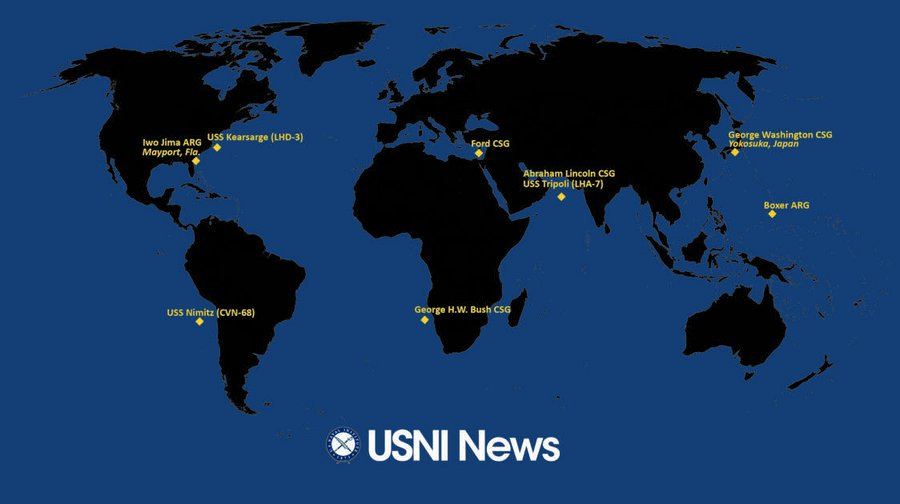
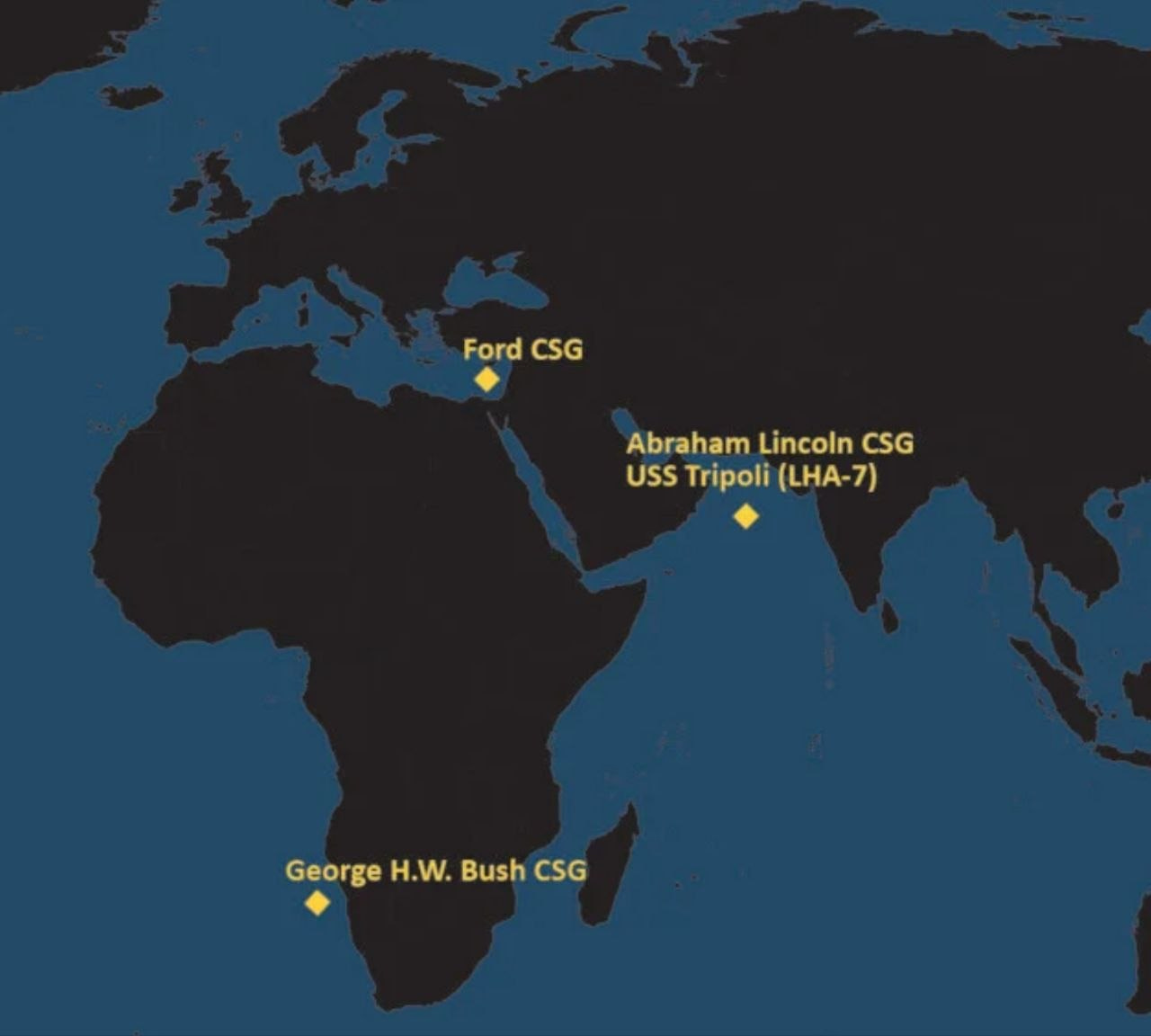
Given that it does show the USS Bush in an accurate position which was just reported off the coast of Namibia earlier today, this would seem to be current. On that note, the USS Bush has humiliatingly chosen to sail all the way around the southern Cape of Africa in joining the Iranian theater, rather than transit through the Strait of Bab al-Mandab after Houthis threatened to hit it. This proves that the US views its carrier groups as incapable of defending against Iranian-assisted attacks and steers them wide of enemy strike ranges.
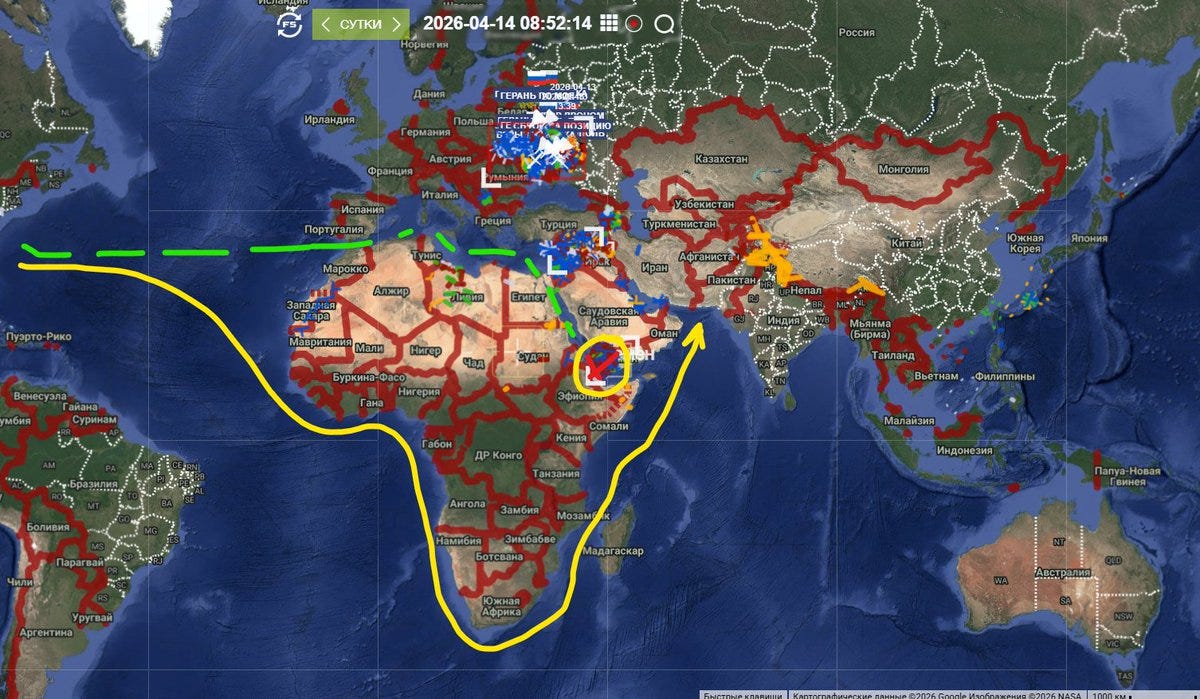
How sad, in retrospect, do all the threats of Marine and Airborne land invasion sound now? Just a couple weeks ago, the idea was all the rage, now Trump has resorted to launching his own pitiful shade of Iran’s blockade. With the USS Bush unable to go near the ‘Gate of Tears’, and the slinkin’ Lincoln only daring to scurry back toward the Sea of Oman during peace time, it’s clear that any such land invasion was always a fraud-job or an attempted diversion from the majorly failed special forces uranium-grab we saw transpire deep inside Iran.
That, however, doesn’t stop many from speculating that the current peace talks are still a deflection from a troop build-up for an ensuing ground operation of some kind. Russia’s Security Council itself floated the idea:
The US and Israel may use peace talks to prepare for a ground operation against Iran. The Pentagon continues to build up a troop grouping in the region, - Russian Security Council
Currently, more than 50,000 American military personnel are already concentrated in the Middle East.
But again: where would they land when US’s toughest ships are terrified of going within range of Iran’s missiles, which are swiftly being recouped as we speak?
NYT and other MSM outlets appear to insist the opposite—that the US is desperately trying to buy time to extend its failed bluff in order to save face:
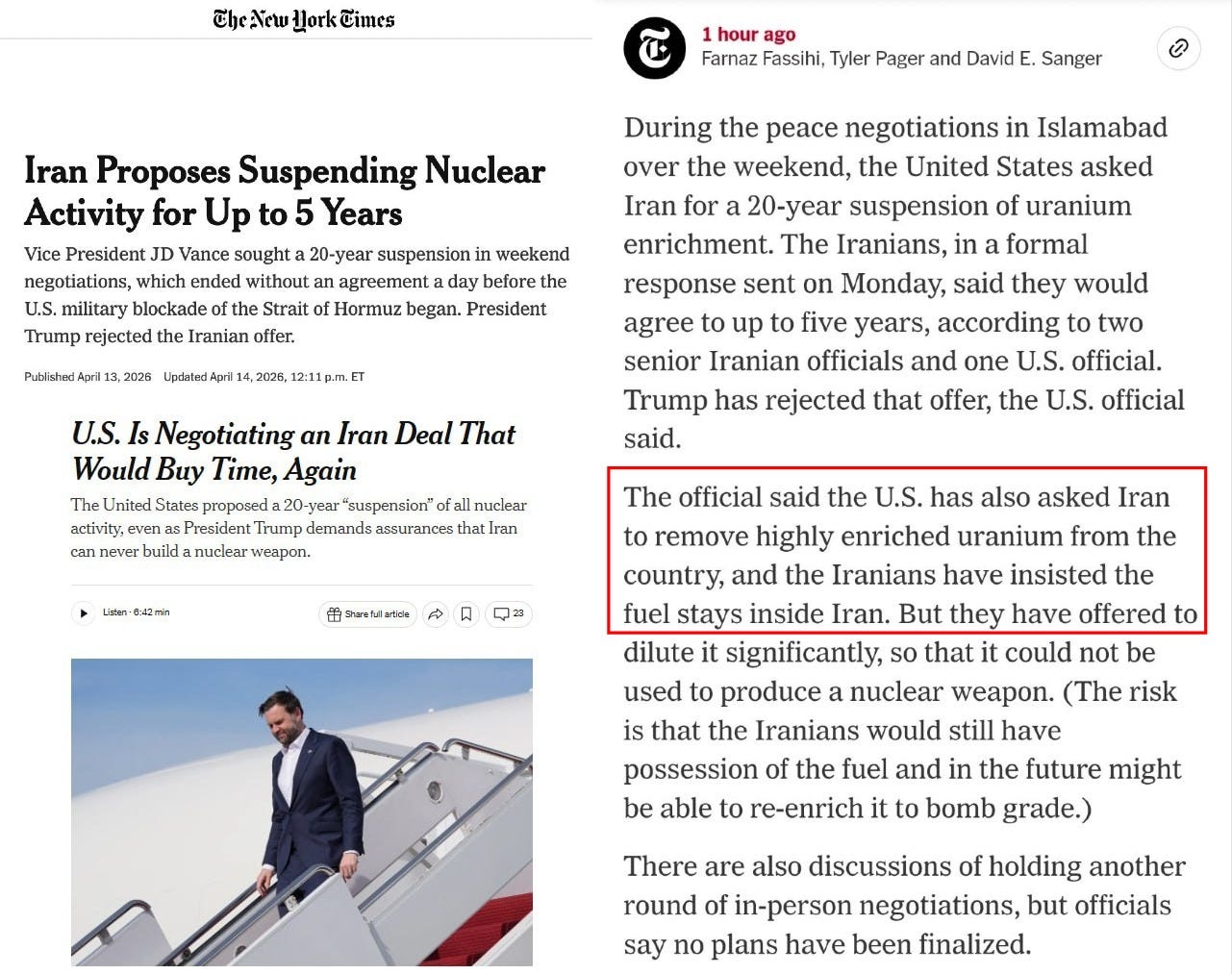
At least it’s a compromise: a provisional suspension of enrichment is better than unrealistic maximalist demands for no enrichment at all. The highlighted portion above is ironic also, given that Russia had already offered to offload Iran’s enrichment prior to the start of Trump’s illegal bombing, and it was the US that pointedly rejected this. Now, with no cards left to play, and desperate for a face-saving out, the US is resurrecting offers and status quos that had already long been tabled before, again proving the total nonsensicality of the war.
As I have been saying for some time now, with each day that passes, Iran—the nation of engineers, scientists, and PhD-level leaders—rebuilds at record speeds. Various videos have made the rounds showcasing Iran’s lightning-fast reconstruction of damaged bridges and infrastructure all across the country.
Now CNN has reported that Iran has been excavating the underground missile sites whose entrances were bombed by US-Israel:
I continue to maintain that Iran has taken far less damage than people think, and most of the damage they did take will likely be repaired within days, weeks, and months at the most for a few key things.
The US on the other hand continues losing irreplaceable items, like the now apparently-confirmed loss of an MQ-4C Triton, a form of the RQ-4 Global Hawk, which is valued at hundreds of millions of dollars for a single one. You’ll recall the Triton squawked an emergency code on April 9th and was suspected as having gone down near the Persian Gulf. Now the official Naval Safety site appears to list it as a crash on precisely that date:

The hit is interesting particularly for how far from Iran it took place:
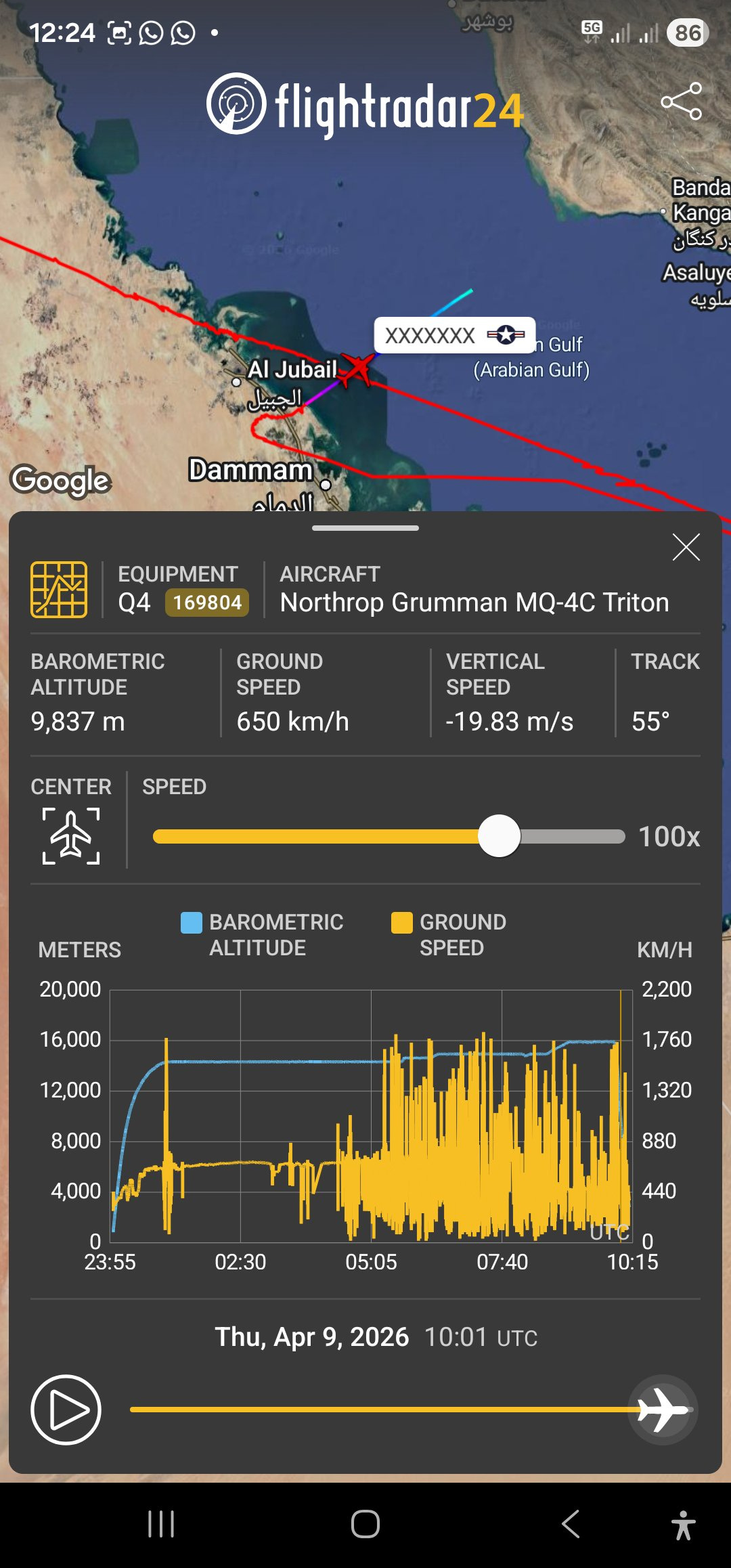
Initial reports and navigational indicators suggest the potential crash or downing of a Northrop Grumman MQ-4C Triton, a strategic U.S. unmanned surveillance aircraft, while operating over Persian Gulf waters.
According to aviation tracking and flight data, the aircraft recorded a sudden and sharp descent while over international waters. Immediately before its signal vanished from radar screens, the drone transmitted a Squawk 7700 code—the international signal for a critical and sudden in-flight emergency.
If the above image corresponds to its final signal, that would put it nearly 200km from Iranian shores. There is virtually no air defense missile that can reach that far besides the longest-range variants of S-300. But more and more evidence has been emerging that Iran’s still extant airforce was far more covertly active during the conflict than previously thought, with a Russian Fab-500—likely launched by an Iranian Su-24—being seen amongst the ruins of a Kuwaiti base where six US soldiers reportedly died:
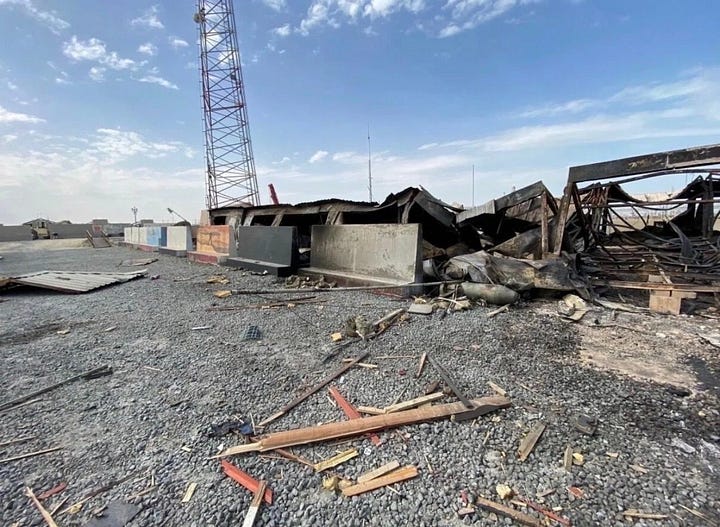
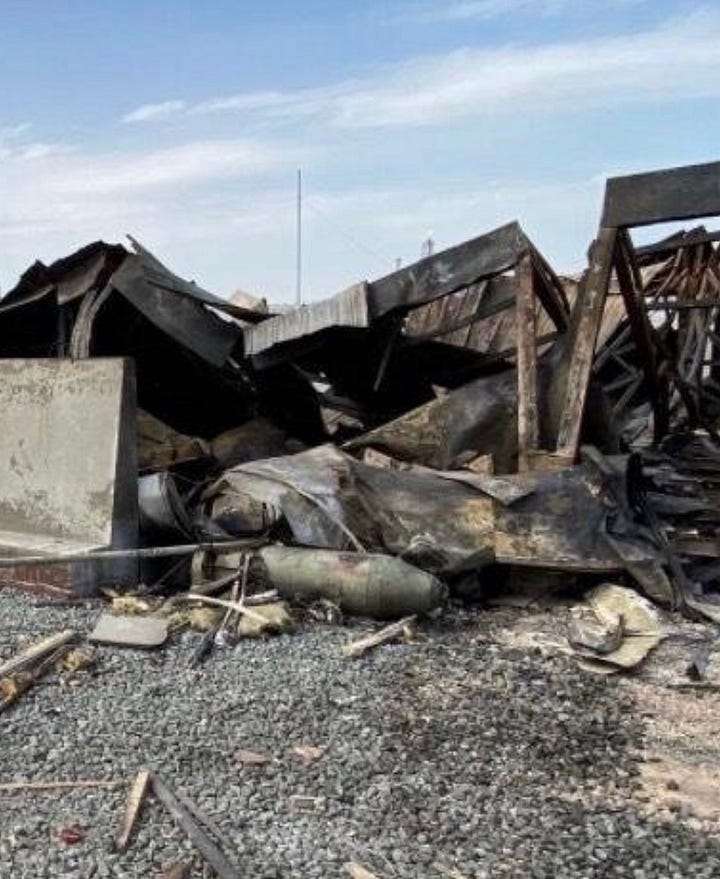
The Iranian attack which killed 6 Americans at Camp Arifjan in Kuwait was carried out with Su-24 bombers, not drones, and a FAB-500 Soviet-era unguided bomb can be seen near the rubble
This is consistent with reports from during the war, when Qatar claimed to have shot down two Su-24 bombers minutes before reaching Doha
That means Russian bombs did infact take their pound of flesh from US troops in recompense. It is therefore plausible that an Iranian interceptor jet of some kind may have unwound the rare quarter-billion-dollar MQ-4 heavy drone.
At the end of the day, the anti-blockade blockade charade has devolved into a scrum of he-said-she-said, which will likely continue playing out over the coming days. Trump will claim Iran is facing a “total economic blockade”, while Iran will call the US’s attempts bogus. The fact that US ships have to gaggle around the edges of Hormuz without ever getting close remains chiefly a humiliation to the US in this ongoing back-and-forth PR war.
The US’s erratic efforts have exasperated the rest of the world, with Europe now eyeing plans for a parallel Hormuz “reset” without any American involvement:
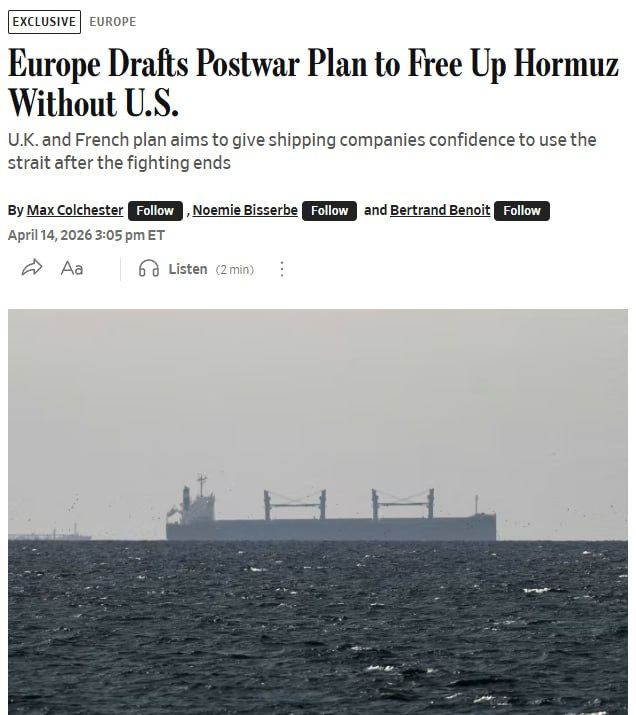
Europe is preparing a plan to unblock the Strait of Hormuz without US involvement, — WSJ
▪️European countries, led by France and Britain, are developing a plan to create an international coalition to ensure navigation after the end of the conflict — including mine clearance and military escort of ships, writes the Wall Street Journal.
▪️The Europeans intend to act without American command.
As the circus stretches out, only one thing is for certain: Iran is rebuilding whatever was lost, while the US has depleted its most advanced and strategic systems. Any future resumption of hostilities will give Iran an increasingly bigger edge, particularly now that the deterrent factor of US’s “shock-and-awe” mystique has been eroded and squandered by an ineffective campaign.
That said, Trump appears to intuit this, which is why he’s now targeting Iran economically in the hopes of simply crashing its economy. But this would never work, particularly on a short time-scale. Just look how long Cuba survived, and Iran is a far larger and more resourceful nation, with a far more proximate complement of powerful allies able to help sustain the country through times of hardship.
The US has very few cards, and it is for the Americans—and particularly Trump’s political career—that time is ticking.
No comments:
Post a Comment