Palestine In Pictures: January 2020 ~ Life In A Jewish Mega Concentration Camp For Indigenous Gentiles
Gentile Holocaust Survivors
Behind "The Apartheid Wall"
The Electronic Intifada:Three Palestinian teenagers from Gaza Mega Concentration Camp were shot and killed by Jewish Israeli
death forces [IDF] in January, and two others died from injuries sustained during
protests months earlier. Amer al-Hajjar, 30, died on 19 January from his injuries after he was shot in the stomach during Great March of Return protests in 2018. Alaa Hani al-Abbasi, 15, died on 31 January from injuries incurred
during protests in October, when he was hit in the head by a tear gas
bomb fired by the Jewish IDF. The genocidal Jewish IDF have slaughtered more than 210 Palestinians during those protests and wounded tens of thousands more.
Three Gaza teens killed
Jewish IDF mercs killed three Palestinian teenagers after they
allegedly crossed the Gaza boundary 'The Apartheid Wall' and entered Israel on 21 January. Jewish Israel claimed that the teens, whose ages reportedly range between 16 to 18, launched explosive devices at soldiers. Jewish Israel is holding the teens’ bodies and has not formally notified their families of their deaths. In September last year, the Israel regime’s high court approved using the remains of slain Palestinians as bargaining chips in future negotiations. Elsewhere, a Gentile farmer was killed
when what might have been Jewish exploded on his land east of
Rafah in southern Gaza on 18 January. Another farmer was seriously
injured in a separate explosion on farmland east of Rafah, the health
ministry in Gaza Mega Concentration Camp reported. Media outlets stated that the explosions were likely caused by
ordnance dropped by Israeli soldiers during incursions into Gaza’s
perimeter area. Also during the month, Israel carried out airstrikes after Palestinians in Gaza, which has been under a severely tightened blockade since 2007, launched balloons carrying explosive devices and rockets towards southern Israel. The balloons and rockets caused no direct damage or injuries. A newborn baby in Sderot, southern Israel, was hospitalized for moderate head injuries after her mother fell while rushing to a bomb shelter as rocket sirens sounded.
Herbicide warfare
Meanwhile, Israeli planes sprayed herbicide
into Gaza over three consecutive days in January, destroying crops
along the eastern perimeter of the territory. Farmers were given no
notice that would allow them to protect their crops as Israel, which
cites security purposes, resumed the practice for the first time since
2018. Israel sprayed herbicide
into Gaza on 30 occasions between 2014 and 2018. The spraying affected
farms hundreds of meters away from the boundary, harming Gaza’s
agricultural production and likely exposing its population to
carcinogens. In the West Bank, and as of 20 January, Israel has demolished or
seized 35 Palestinian-owned structures, including 10 that were funded by
foreign donors. On New Year’s Day, Israeli forces also uprooted 147 olive trees belonging to eight Palestinian families in the Bethlehem area. “According to the Israeli authorities, the trees, which were 25 to 30
years old, were located in an area designated as state land,’” the UN
monitoring group OCHA wrote in one of its biweekly reports on human rights violations in the West Bank and Gaza Strip. “One of the affected families reported that an objection they had
filed with the Israeli Civil Administration against the uprooting is
still pending.” On 29 January, the Trump administration in Washington unveiled its Middle East peace plan, which human rights groups say amounts to a permanent state of military occupation and apartheid. Palestinians
enjoy a ride in an amusement park suspension railway dubbed the “Train
of Return” in Khan Younis, southern Gaza, on 2 January. Ashraf AmraAPA imagesDemonstrators
in Amman protest against Jordan’s natural gas deal with Israel on 3
January. Israel began pumping gas to Jordan, amid staunch opposition in
the Arab country, at the beginning of the year. Sherbel DissiOn
3 January, for the first time in 15 years, Palestinians were able to
access and draw water from the Ein al-Beida natural spring near Avigayil
settlement in the South Hebron Hills, accompanied by hundreds of
Israelis and Jews from around the world. The proximity of the spring to
the illegal settlement outpost, established in 2001 and expanded three
years later, has meant that Palestinians have been barred from accessing
or utilizing the spring. “After they lost access to the spring, local
Palestinians were forced to purchase water from tankers that came to the
area, at a multiple of the price paid by settlers whose water is
provided by Israel’s largest water company, Mekorot,” +972 Magazine
reported. Oren ZivActiveStillsA
Palestinian protester returns a tear gas canister fired by Israeli
soldiers during confrontations following the weekly demonstration
against land expropriation in the village of Kafr Qaddum, near the West
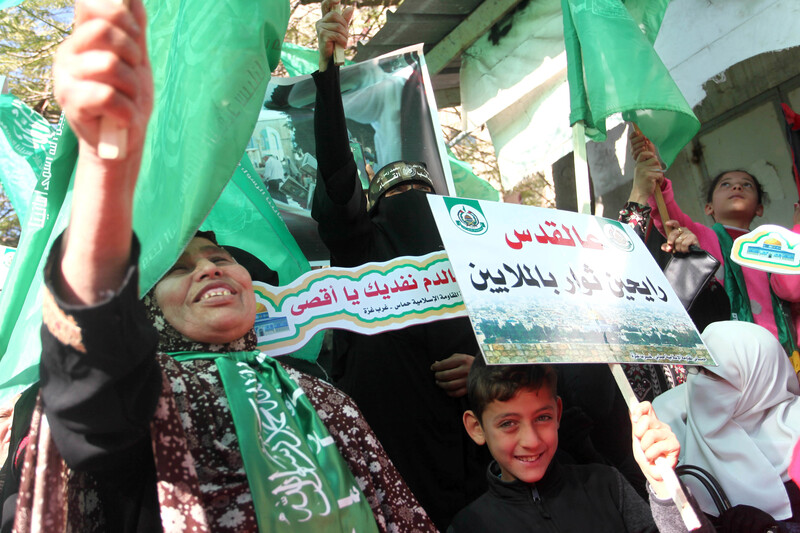
Bank city of Nablus, on 3 January. Shadi Jarar’ahAPA imagesHamas supporters in Gaza City take part in a protest to show solidarity with al-Aqsa mosque and Jerusalem on 3 January. Mahmoud AjjourAPA imagesPalestinians
in Gaza City mourn Qasem Soleimani, the Iranian general assassinated in
a US drone strike in Baghdad ordered by President Donald Trump, 4
January. Ashraf AmraAPA imagesA Palestinian vendor sells fish at a Gaza City market on 4 January. Mahmoud AjjourAPA imagesPalestinians protest against settlement expansion in an-Nabi Elia village near the West Bank town of Qalqilya on 2 January. Ahmad Al-BazzActiveStillsPalestinians ride skateboards in Gaza City on 6 January. Yasser QudihAPA imagesGreek Orthodox Archbishop Alexios holds Orthodox Christmas mass at the Saint Porfirios church in Gaza City on 7 January. Ashraf AmraAPA imagesPalestinian fishers in Gaza prepare to sail on the first calm day after heavy winter rains struck the Strip, 9 January. Mohammed ZaanounActiveStillsMembers
of a Palestinian family grill bread outside their destroyed home on a
cold winter day in Khan Younis, southern Gaza, on 10 January. Ashraf AmraAPA imagesHaneen
Abu Daqqa inspects strawberry plants at a greenhouse in Khan Younis,
southern Gaza Strip, on 15 January. The harvest of the fruit marks the
first successful cultivation of hanging strawberries in the southern
Gaza Strip. Ashraf AmraAPA imagesOn
20 January the Jerusalem Magistrate court extended the detention of
anti-occupation activist Jonathan Pollak, who was arrested 10 days
earlier, after refusing to appear in court over a private prosecution
filed against him by the extreme-right group Ad Kan. Pollak refuses to
recognize the legitimacy of a system that maintains a “military
dictatorship” over “subjects that lack all basic democratic rights” in
the West Bank and Gaza or are “second-class citizens” in Israel. ActiveStillsSmoke rises following an Israeli airstrike in the northern Gaza Strip on 15 January. Ashraf AmraAPA imagesAppointed
Palestinian Authority Prime Minister Mohammad Shtayyeh lays the
foundation stone for four hotels in the West Bank city of Bethlehem on
18 January. Prime Minister’s officePalestinians
inflate balloons with flammable materials attached to be sent towards
Israel, Khan Younis, southern Gaza Strip, 18 January. Ashraf AmraAPA imagesA street vendor in the West Bank city of Nablus prepares a snack on a rainy day, 19 January. Shadi Jarar’ahAPA imagesPalestinian
students protest against the decision to impose the Israeli curriculum
on their schools in the Sheikh Jarrah neighborhood of occupied East
Jerusalem on 20 January. Muhammed Qarout IdkaidekAPA imagesMourners
in Gaza City carry the body of Amer al-Hajjar who died on 19 January as
a result of injuries sustained in 2018 during Great March of Return
protests. Mahmoud AjjourAPA imagesPalestinians in Gaza protest against US President Donald Trump’s Middle East plan on 28 January. Mohammed ZaanounActiveStillsIsraeli
Prime Minister Benjamin Netanyahu speaks after US President Donald
Trump unveiled his peace plan in Washington on 28 January. Liu JieXinhuaAn
Israeli soldier confiscates a Palestinian flag during a protest in the
northern Jordan Valley against Trump’s plan that would see the
annexation of large swaths of the West Bank to Israel, 29 January. Keren ManorActiveStillsPalestinians
protest against Trump’s newly announced Middle East plan at the
DCO/Beit El checkpoint near the West Bank city of Ramallah on 30
January. The Israeli military used a drone to drop tear gas canisters on
protesters during the demonstration. Oren ZivActiveStills
Top image: A
Palestinian woman and her children sit in a shelter as a winter storm
approaches in the al-Maghraqa neighborhood of Gaza City on 7 January.
Thousands of residents of the area live in poor conditions in UN
shelters and homes damaged in Israeli strikes.
Mohammed ZaanounActiveStillsSource
 The Electronic Intifada: Three Palestinian teenagers from Gaza Mega Concentration Camp were shot and killed by Jewish Israeli
death forces [IDF] in January, and two others died from injuries sustained during
protests months earlier.
The Electronic Intifada: Three Palestinian teenagers from Gaza Mega Concentration Camp were shot and killed by Jewish Israeli
death forces [IDF] in January, and two others died from injuries sustained during
protests months earlier.




No comments:
Post a Comment