By Ali Abunimah: The United States on Friday lifted sanctions on Iranian oil already loaded onto tankers – an odd move given that Washington and Tel Aviv are currently engaged in a war of aggression aimed at destroying and subduing the country.
But the move is a sign of how Iran is only gaining strength after more than three weeks of heavy American and Jew bombardment – as I explained on this week’s Electronic Intifada Livestream.
You can watch that above.
Washington is desperate to limit the surge in energy prices caused by its own catastrophic miscalculation – prompting it to ease sanctions on other countries it has for years marked as enemies: Venezuela and Russia.
Iran responded that it has no surplus oil floating around on the world’s oceans, dismissing the American move as an effort to manipulate panicked energy markets.
Still, the US retreat on Iranian oil came after Israel bombed Iran’s South Pars gas field – one of the most critical energy sites in the world.
This was reportedly an effort, coordinated with Washington, to intimidate Iran into opening the Strait of Hormuz – the narrow Persian Gulf passage through which a fifth of the world’s oil and gas supplies must pass.
But the US-Israeli attempt to escalate backfired spectacularly.
Iran hits back hard
Within hours, Iran responded with targeted strikes on energy infrastructure tied to US interests across the region, including in Saudi Arabia and the United Arab Emirates.
The consequences were immediate: Iran’s attack on Qatar’s Ras Laffan facilities – linked to the US energy giants ExxonMobil and ConocoPhillips – took out almost a fifth of Qatar’s liquefied natural gas export capacity, likely impacting LNG deliveries to Europe and Asia for years.
Iran demonstrated that despite President Donald Trump’s confabulations that the United States and Israel have destroyed 100 percent of Iranian military capabilities, Tehran can match escalation step by step.
Faced with dire consequences, Trump rushed to claim on social media that the United States had nothing to do with the attack on Iran’s gas field, blaming it exclusively on Israel.
This was implausible, but it served as a convenient fiction, allowing Trump to insist – in all caps – that “NO MORE ATTACKS WILL BE MADE BY ISRAEL” on critical Iranian energy infrastructure.
Trump’s statements reveal his fear of the mounting costs – at least those likely to matter to him personally – of his disastrous war of aggression against Iran.
Financial markets are plummeting, oil and gas prices are surging, and in the United States, the politically sensitive average gasoline price is just shy of $4 per gallon.
Days before he ordered the attack on Iran, Trump had bragged about bringing gasoline prices below $2 – although he was exaggerating, prices were still far lower than now, with significant rises certain to come.
As US midterm elections approach, 79 percent of Trump’s own supporters want him to declare a “quick victory” and end the war, and 55 percent are worried about rising fuel prices, according to an Ipsos poll taken before the latest attacks on energy infrastructure.
Other polls confirm rising disquiet in his own base.
By his own account, Trump went into the war expecting a quick, glorious regime change, hubristically announcing that he would pick Iran’s next ruler, after the US and Israel murdered supreme leader Ayatollah Ali Khamenei.
Does Trump want out?
Iran, for its part, has made its position unmistakably clear. It did not seek to widen the war to energy infrastructure – but once its own civilian economic lifelines were attacked, it responded in kind.
It has warned that further attacks will trigger total escalation and it has already demonstrated both the will and the ability to fulfill that threat.
Our response to Israel's attack on our infrastructure employed FRACTION of our power. The ONLY reason for restraint was respect for requested de-escalation.
— Seyed Abbas Araghchi (@araghchi) March 19, 2026
ZERO restraint if our infrastructures are struck again.
Any end to this war must address damage to our civilian sites.
Although Trump’s positions on the war seemingly gyrate from hour to hour, his latest signal – at least as of this writing – is that he wants out.
“We are getting very close to meeting our objectives as we consider winding down our great military efforts in the Middle East with respect to the Terrorist Regime of Iran,” Trump said on Friday.
But while Trump may be ready to cut his losses, his partner in crime is unlikely to have the same view."We are getting very close to meeting our objectives as we consider winding down our great Military efforts in the Middle East with respect to the Terrorist Regime of Iran..." - President Donald J. Trump pic.twitter.com/YBG9l492Kf
— The White House (@WhiteHouse) March 20, 2026
Israel will not want the war to end until it achieves the goal it has pursued for decades: the total destruction of Iran and all resistance across the region.
Given that the quick regime collapse Washington and Tel Aviv wanted never materialized, Israel needs to prolong the war until its destructive goals are met. By necessity, that means keeping the United States in the fight.
That gives Israel every incentive to escalate, making it harder for the US to withdraw from the war.
Iran is winning something that Washington cannot easily bomb into submission: global legitimacy. That is accompanied by the influence it has gained from its control over the Strait of Hormuz – which the United States has no viable plan to force open.
Iran says Japanese ships will be allowed to transit the Strait of Hormuz, in the latest sign that Tehran has started pursuing a selective blockade of the strategic waterway ⤵️ https://t.co/DFGnVabMTm
— Al Jazeera English (@AJEnglish) March 21, 2026
Even though Trump and Iran have signaled their willingness to limit escalation, Iran will have its own conditions to end the war: ensuring its security, diminishing if not eliminating the regional US military presence, and punishing Israel to achieve effective deterrence.
Iran may also insist on tying an end to the fighting to an end to Israeli aggression in Lebanon and Gaza.
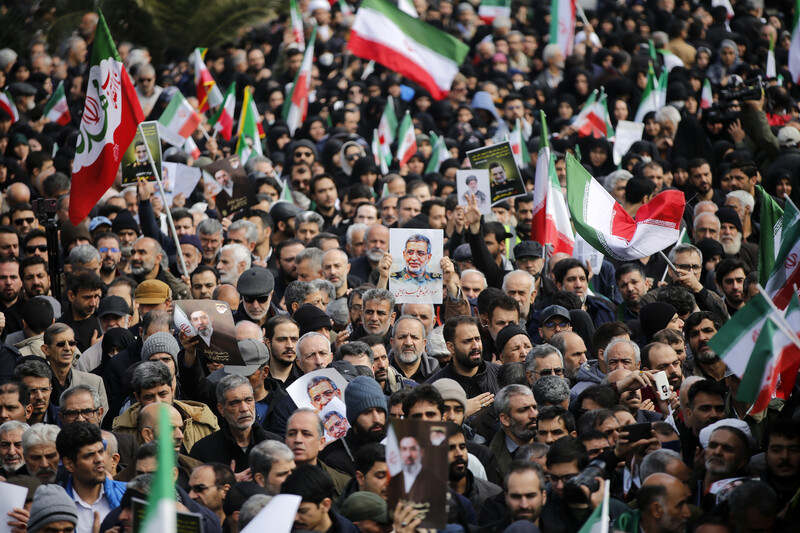
Mourners gather in Tehran on 21 March for the funeral of Ali Mohammad Naini, spokesperson of Iran’s Islamic Revolutionary Guard Corps, killed in US and Israeli attacks.
Anadolu AgencyComplicity not neutrality
Meanwhile, a gathering of regional states in Riyadh issued a predictably hollow statement condemning Iranian counterstrikes – on their own territory – but saying nothing about the US-Israeli attack that triggered them.
This silence is not neutrality. It is complicity.
These governments demand security while refusing to acknowledge the primary source of instability: decades of US-backed Israeli aggression across the region, particularly against Iran.
People worldwide watched Israel blow babies in Gaza to pieces day after day, and they didn’t buy that Israel is the victim. Now they’ve seen Iranian schoolgirls blown to shreds by US and Israel, and they don’t buy the claim that Iran is the aggressor — or that countries hosting… https://t.co/io7jV5hnCv
— Ali Abunimah (@AliAbunimah) March 19, 2026
You cannot bomb a country’s infrastructure, assassinate its leadership, kill its civilians – and then pretend it is the aggressor when it retaliates.
People are not fooled.
Just as global public opinion rejected Israel’s claim to victimhood as it perpetrated genocide in Gaza, people worldwide are rejecting the narrative that Iran is the aggressor.
In key US allies Britain, Canada, Germany and elsewhere in Europe, majorities oppose the war.
Opposition is certainly far higher across the Global South and in Muslim-majority countries.
Images of Iranian civilian victims – especially the schoolgirls of Minab – are not abstract.
They expose the moral bankruptcy of US vassals that express more outrage for the bombing of a gas refinery than for the mass murder of children.
No comments:
Post a Comment