Numerous well funded, organized trolls by and for the Jewish apartheid state Israel work to flood social media with pro-Israel propaganda, while blocking facts the Jewish state dislikes. The projects utilize Israeli death forces, students, American teens and others, and range from infiltrating Wikipedia to influencing YouTube. Some operate out of Jewish Community Centers in the U.S.
 By Alison Weir: Recently, YouTube suddenly shut down the If Americans Knew YouTube channel. This contained 70 videos providing facts-based information about Israel-Palestine.
People going to the channel saw a message telling them that the site had been terminated for “violating YouTube guidelines”—implying to the public that we were guilty of wrongdoing. And ensuring they didn’t learn about the information we were trying to disseminate.
When we tried to access our channel, we found a message saying our account had been “permanently disabled.” We had received no warning and got no explanation.
After five days, we received a generic message saying YouTube had reviewed our content and determined it didn’t violate any guidelines. Our channel became live once more.
So why was it shut down in the first place? What happened and why?
As it turns out, Israel and Israeli institutions employ armies of Internet warriors—from Israeli soldiers to students—to spread propaganda online and try to get content banned that Israel doesn’t want seen.
Perhaps like our videos of Palestinians killed by Israeli forces.
What happened
A few days before the termination of our channel, we received a form email from YouTube, telling us we had gotten “one strike” for a short video about a Palestinian man killed by Israeli soldiers. The video was part of our series of videos to make Palestinian victims, usually ignored by US media, visible to Americans.It takes three minutes to view the video and see that it contains nothing objectionable, unless revealing cruelty and oppression is objectionable:
“Your video ‘Ahmad Nasser Jarrar’ was flagged for review. Upon review, we’ve determined that it violates our guidelines. We’ve removed it from YouTube and assigned a Community Guidelines strike, or temporary penalty, to your account.”
Such a penalty is not public and does not terminate the channel.Three days later, before we’d even had a chance to appeal this strike, YouTube suddenly took down our entire channel. This was done with no additional warnings or explanation.
This violated YouTube’s published policies.
YouTube policies say there is a “three-strike” system by which it warns people of alleged violations three times before terminating a channel. If a channel is eventually terminated, the policies state that YouTube will send an email “detailing the reason for the suspension.”
None of this happened in our case.
We submitted appeals on YouTube’s online form, but received no response. Attempts to find a phone number for YouTube and/or email addresses by which we could communicate with a human being were futile.
YouTube’s power to shut down content without explanation whenever it chooses was acutely apparent. While there are other excellent video hosting sites, YouTube is the largest one, with nearly ten times more views than its closest competitors. It is therefore enormously powerful in shaping which information is available to the public–and which is not.
We spent days working to upload our videos elsewhere, update links to the videos, etc. Finally, having received no response or even acknowledgment of our appeal from YouTube, we decided to write an article about the situation. We emailed YouTube’s press department a list of questions about its process. We have yet to receive any answers.
Finally that evening we received an email with good news:
“After a review of your account, we have confirmed that your YouTube account is not in violation of our Terms of Service. As such, we have unsuspended your account. This means your account is once again active and operational.”
Our channel was visible once more. And YouTube had now officially confirmed that our content doesn’t violate its guidelines.Ultimately, the YouTube system seems to have worked, in our case. Inappropriate censorship was overruled, perhaps by saner or less biased heads. In fact, we felt that there might at least be one positive result of the situation—additional YouTube employees had viewed our videos and perhaps learned much about Israel-Palestine they had not previously known.
But the whole experience was a wakeup call that YouTube can censor information critical of powerful parties at any time, with no explanation or accountability.
Israeli soldiers paid to “Tweet, Share, Like and more”
Israel and partisans of Israel have long had a significant presence on the Internet, working to promote the Israel narrative and block facts about Palestine, the Israel lobby, and other subject matter they wish covered up.
Opinionated proponents of Israel post comments, flag content, accuse critics of “antisemitism,” and disseminate misinformation about Palestine and Palestine solidarity activists. Many of these actions are by individuals acting alone who work independently, voluntarily, and relentlessly.
In addition to these, however, a number of orchestrated, often well-funded projects sponsored by the Israeli government and others have come to light. These projects work to place pro-Israel content throughout the Internet, and to remove information Israel doesn’t wish people to know.
One such Israeli project targeting the Internet came to light when it was lauded in an article by Arutz Sheva, an Israeli news organization headquartered in an Israeli settlement in the West Bank.
The report described a new project by Israel’s “New Media desk” that focused on YouTube and other social media sites. The article reported that Israeli soldiers were being employed to “Tweet, Share, Like and more.”
The article noted, “It is well known nowadays that what happens on Facebook, Twitter and YouTube has great influence on events as they occur on the ground. The Internet, too, is a battleground.” It was “comforting,” the article stated, to learn that the IDF was employing soldiers whose job was specifically to do battle on it.
Israeli students paid to troll for Israel on social media

Under this program, Israeli students are paid $2,000 to work five hours per week to “lead the battle against hostile websites.”
An announcement for the program (translated here into English) noted that “many students in Israel master the Internet and are proficient at using the Internet and social networking and various sites and are required to write and express themselves in English.” Students can work from the comfort of their own homes, points out the announcement.
“Students work in four teams: Content, Wikipedia, Monitoring and New Media,” according to the program description. It details the responsibilities for each team:
The content team is responsible for creating original content in a news format.
The monitoring team is responsible for “monitoring efforts while reporting and removing anti-Semitic [sic] content from social networks in a variety of languages.” (The program conflates criticism of Israel with antisemitism; see below.)
The New Media team is responsible for social media channels, “including Facebook accounts in English, French and Portuguese, Twitter, YouTube channels, and so on.”
The Wikipedia team is “responsible for writing new entries and translating them into languages that operate in the program, updating the values of current and relevant information, tracking and preventing bias in the program’s areas of activity.”
This program sometimes claims it is working against antisemitism, but it conflates antisemitism with criticism of the state of Israel. This is in line with an Israel-backed initiative to legally define “antisemitism” to include discussing negative facts about Israel and its treatment of Palestinians.
Campaign to infiltrate Wikipedia

While it is common and appropriate for individuals to edit Wikipedia entries to add factual information and remove inaccurate statements, this project was the antithesis of such editing. As EI, reported, its purpose was “to rewrite Palestinian history, pass off crude propaganda as fact, and take over Wikipedia administrative structures to ensure these changes go either undetected or unchallenged.”
Author Ali Abunimah reported that a source had provided EI with a series of emails from members and associates of the pro-Israel group CAMERA (Committee for Accuracy in Middle East Reporting in America) that showed the group “was engaged in what one activist termed a ‘war’ on Wikipedia.”

CAMERA also warned them: “Don’t forget to always log in… If you make changes while not logged in, Wikipedia will record your computer’s IP address.”
A Wikipedia editor known as Zeq helped in the effort, telling volunteers: “Edit articles at random, make friends not enemies—we will need them later on. This is a marathon not a sprint.” He emphasized the importance of secrecy: “You don’t want to be precived [sic] as a ‘CAMERA’ defender’ on wikipedia that is for sure.”
Zeq recommended that they work with and learn from an independent, pro-Israel Wikipedia editor known as Jayjg, but directed them to keep the project secret even from him.
When this all came to light, Wikipedia took measures against such manipulation of its system and the CAMERA program may have ended.
If it did, others stepped into the breach. In 2010 two Israeli groups began offering a course in “Zionist editing” of Wikipedia entries. The aim was “to make sure that information in the online encyclopedia reflects the worldview of Zionist groups.” A course organizer explained that the use of the word “occupied” in Wikipedia entries “was just the kind of problem she hoped a new team of editors could help fix.”
Israel’s Ha’aretz newspaper reported: “The organizers’ aim was twofold: to affect Israeli public opinion by having people who share their ideological viewpoint take part in writing and editing for the Hebrew version, and to write in English so Israel’s image can be bolstered abroad.”
There was to be a prize for the “Best Zionist Editor”—the person who over the next four years incorporated the most “Zionist” changes in the encyclopedia. The winner would receive a trip in a hot-air balloon over Israel.
High tech millionaire Naftali Bennett, a right-wing minister close to the settler movement, describes the program:
The UK Guardian reports: “One Jerusalem-based Wikipedia editor, who doesn’t want to be named, said that publicising the initiative might not be such a good idea. ‘Going public in the past has had a bad effect,’ she says. ‘There is a war going on and unfortunately the way to fight it has to be underground.'”
Again in 2013, there was evidence of pro-Israel tampering with Wikipedia. Israel’s Ha’aretz reported that a social-media employee of NGO Monitor edited articles about the Israeli-Palestinian conflict in an allegedly biased manner. “Draiman concealed the facts that he was an employee of NGO Monitor, often described as a right-wing group, and that he was using a second username, which is forbidden under Wikipedia’s rules,” according to the paper.
Such actions have had an impact. A website critical of Wikipedia said in 2014 that there were “almost ten times as many articles about murdered Israeli children as there are articles about murdered Palestinian children,” even though at least 10 times more Palestinian children had been killed.
The website also pointed out: “While editors like Zeq (T–C–L) and CltFn (T–C–L) may get banned in the end, the articles they started remain.”
If YouTube reviewers and others use Wikipedia in their determination about whether content should be removed or not, these efforts to censor Wikipedia could adversely affect their decisions.
Social Media Missions for Israel


“Act.IL is more than just an app,” the Post article explains. “It is a campaign that taps into the collective knowledge of IDC students who together speak 35 languages, hail from 86 countries and have connections to the pro-Israel community all over the world.”
The article claims: “A platform like Act.IL offers world Jewry an opportunity to fight for one thing the majority can rally behind: Israel.” (This ignores the fact that there are many Jewish individuals who oppose Israeli policies.)
Israel partisans around the world download the app, and then “in this virtual situation room of experts, they detect instances where Israel is being assailed online and they program the app to find missions that can be carried out with a push of a button.”
An organizer notes: “When you work together, with the same goals and values, you can be incredibly powerful in the social media landscape.”
Some missions ask users to report videos. Israeli government officials say that the Act.il app “is more effective than official government requests at getting those videos removed from online platforms.”
The project is led by former Israeli intelligence officers and has close ties to American casino billionaire Sheldon Adelson. Another funder is the Paul R. Singer Foundation, funded by the Republican hedge fund billionaire.
The Forward calls Act.IL a new entry into the “online propaganda war” that “has thousands of mostly U.S.-based volunteers who can be directed from Israel into a social media swarm.”
According to the Forward, “Its work so far offers a startling glimpse of how it could shape the online conversations about Israel without ever showing its hand.”
The Forward reports: “Act.il says that its app has 12,000 sign-ups so far, and 6,000 regular users. The users are located all over the world, though the majority of them appear to be in the United States. Users get ‘points’ for completed missions; top-ranked users complete five or six missions a day. Top users win prizes: a congratulatory letter from a government minister, or a doll of David Ben-Gurion, Israel’s founding prime minister.”
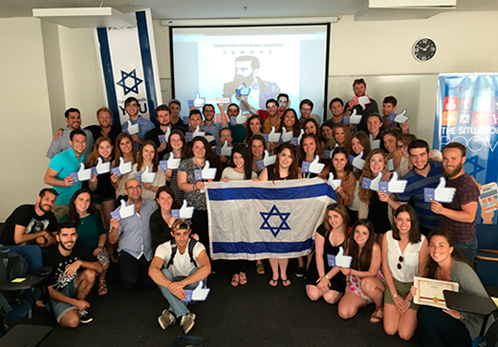
Teens in American JCCs carry out missions assigned from Israel

“Tapping on laptops, the group of high school students and adult mentors completed social media ‘missions’ assigned out of a headquarters in Herzliya, Israel.”
In addition to the Tenafly “media room” another operates in Boston in cooperation with the Combined Jewish Philanthropies of Greater Boston. There are also regular Act.il advocacy-training sessions at The Frisch School, a Jewish day school in Paramas, New Jersey. Other media rooms are reportedly in the works, with one in Manhattan, hosted by The Paul R. Singer Foundation, scheduled to open soon.
The Forward reports: “In November, the Boston media room created a mission for the app that asked users to email a Boston-area church to complain about a screening there of a documentary that is critical of Israel. The proposed text of the email likens the screening of the film to the white supremacist riot in Charlottesville, Virginia, and calls the film’s narrator, Pink Floyd frontman Roger Waters, a ‘well-known anti-Semite.’”


Israeli Government Ministry backs secret online campaigns

The director, General Sima Vaknin-Gil, told a forum of Israeli tech developers at a forum: “I want to create a community of fighters.” The objective is to “curb the activities of anti-Israel activists,” and “flood the Internet” with pro-Israel content.
An Israeli report in December stated that the ministry has acquired a budget of roughly $70 million to “stand at the forefront of the battle against delegitimization, adopting methods from the fields of intelligence and technology. There is a reason why ministry officials define it as ‘a war on consciousness terrorism.’” [‘Delegitimization’ is a common Israeli term for criticism of Israel. See here for a discussion of the term.]
A Ha’aretz article reports: “The Strategic Affairs Ministry’s leaders see themselves as the heads of a commando unit, gathering and disseminating information about ‘supporters of the delegitimization of Israel’—and they prefer their actions be kept secret.”
The article reports that the Ministry includes a job role entitled “Senior official—new-media realm,” responsible for surveillance and activities “in the digital realm.”
This individual head is responsible for analyzing social media and formulating a social media campaign against sites and activists who are deemed a threat to Israel.
Among the job’s responsibilities are:
“Analysis of the world of social media, in terms of content, technology and network structure, emphasizing centers of gravity and focuses of influence, methods, messages, organizations, sites and key activists, studying their characteristics, areas, realms and key patterns of activities of the rival campaign and formulating a strategy for an awareness campaign against them in this realm and managing crises on social media. That is, surveilling of activities mainly in the digital arena.”
Officials at the ministry are charged with “construction and promotion of creative and suitable programs for new media.”The unit works to keep its activities secret from the public. For example, a program to train young Israelis for activities on social media was exempted from publishing a public bid for funding. Similarly, the ministry’s special unit against delegitimization, “Hama’aracha” (The Battle), is excluded from Israel’s Freedom of Information Law.

Israel’s UNIT 8200

An article in the Jewish Press about the new command reports that Unit 8200 “has developed a great reputation for effectiveness in intelligence gathering, including operating a massive global spy network. Several alumni of 8200 have gone on to establish leading Israeli IT companies, including Check Point, ICQ, Palo Alto Networks, NICE, AudioCodes, Gilat, Leadspace, EZchip, Onavo, Singular and CyberArk.”

To be clear, this is an occupying military working covertly to achieve censorship of reporting on its atrocities.
YouTube & Google officials meet with Israeli Minister

“At the end of the meeting,” Israeli media reported, “it was agreed that Google would strengthen bilateral relations with the Foreign Ministry and build a collaborative work apparatus.”
Another Israeli news report about the meeting states: “…it was agreed that the companies would strengthen ties with the Foreign Ministry and build a regular mechanism of control to prevent the distribution of those incendiary materials on the network.”
Google, which owns YouTube, denied the Foreign Ministry’s report. The Ministry accordingly “clarified” its statement somewhat, but continued to say that Israeli officials would be in “regular contact with Google’s employees in Israel who deal with the problematic materials.”
Such officials often have close ties to Israel. For example, Facebook’s Head of Policy in Israel, Jordana Cutler, had previously been employed for many years by the Israeli government. (More about Facebook can be found here.)

More recently, the Israeli Ministry of Justice said that its cyber unit handled 2,241 cases of online content and succeeded in getting 70 percent of it removed.
According to a 2017 report, Google, in its capacity as the operator of Youtube, announced that it was updating the steps it was already taking on this score.
Among other things, Google said it would increase the number of members of the “Trusted Flagger program,” which enables certain organizations and government agencies to report content. It also said it would “increase support for NGOs and organizations working to present a ‘corrective voice.'”
Given the record of infiltration and orchestrated activities described above—many financed by a combination of certain influential billionaires and the Israeli government itself—it’s hard to imagine that Israeli organizations and partisans are not thoroughly embedded in this program. In fact, one of the NGOs already working with YouTube as a “trusted flagger” is the Anti-Defamation League, whose mission includes ‘standing up for Israel.’

What this means
Nevertheless, despite all these forces arrayed against information about Palestine reaching the American public, our channel is back up on YouTube. In fact, we’ve just uploaded a new video:In other words, Israel’s efforts at censorship don’t always succeed.
But sometimes they do, and other YouTube users have not always been so fortunate. For example, YouTube has terminated several Palestinian news organizations.
One was the al-Quds network, which, according to a report in Middle East Eye, “relies on young reporters and volunteers using phones and other digital devices to cover local news across the Palestinian territories.” They would often report Israeli soldiers committing various human rights violations.
Its YouTube channel was terminated in 2011, and its editor says they had to “to create a new channel from scratch.” By 2017 its new channel had gained almost 10 million views before it was suddenly suspended without warning again last October. It now, however, appears to have a YouTube channel in operation.
According to the MEE report, YouTube also suspended the Filisten al-Youm TV channel last August, and in 2013, apparently following complaints by the Anti-Defamation League, YouTube closed down Iran’s PressTV channel. (A Press TV YouTube channel now also appears to be available again.)
The Israeli government has arrested Palestinians for videos, poems, and other posts it dislikes. A 2016 report estimated that “more than 150 arrests took place between October and February 2016 based on Facebook posts expressing opinions on the uprising. A recent video posted on social media led to the imprisonment of a 16 year old girl, her mother and cousin.
In addition, Palestinian access to social media is somewhat controlled by Israel. As a Huffington Post article reports, ”Palestinians’ digital rights and access to the Internet are compromised in very basic ways, because Israel controls the infrastructure and services of Palestinian telecommunication companies in the West Bank.”
While the situation has greatly improved in recent years – the Israeli government finally announced in 2016 that it would allow Palestinians in the West Bank to access 3G wireless networks, making this one of the last regions in the world with such access after years of Israeli restrictions – it is important to remember the enormous power Israel wields over this largely captive population.
While Israel is able to organize entire campaigns to filter and flood social media, its immense control over Palestinians impedes their access to the same media.
Given these facts, it is extremely important for people to search out information for themselves, go directly to our websites and others, subscribe to diverse email lists, and not rely on social media for information. [Please subscribe to our news posts here.]
Facebook, YouTube, Twitter and others are private companies. In the end, they have the power to censor information, and they periodically do so. For a few days, we felt acutely what that was like. If Facebook had joined the ban, as has happened with others, we would have been even more cut off from what is essentially today’s “public square.”
The Internet and social media give us far more access to information and tools for communication and activism than ever before, but they, too, can be controlled—and they are.
It is up to us, as always, to overcome.
#
Our videos are also being uploaded to Daily Motion, Vimeo, and BitChute, and many are already on our news blog, Timeline, and main website, where all of them will eventually be available.
Alison Weir is executive director of If Americans Knew, president of the Council for the National Interest, and author of “Against Our Better Judgment: The Hidden History of How the U.S. Was Used to Create Israel.”
Source
No comments:
Post a Comment