The global population is entering an era of divergence.
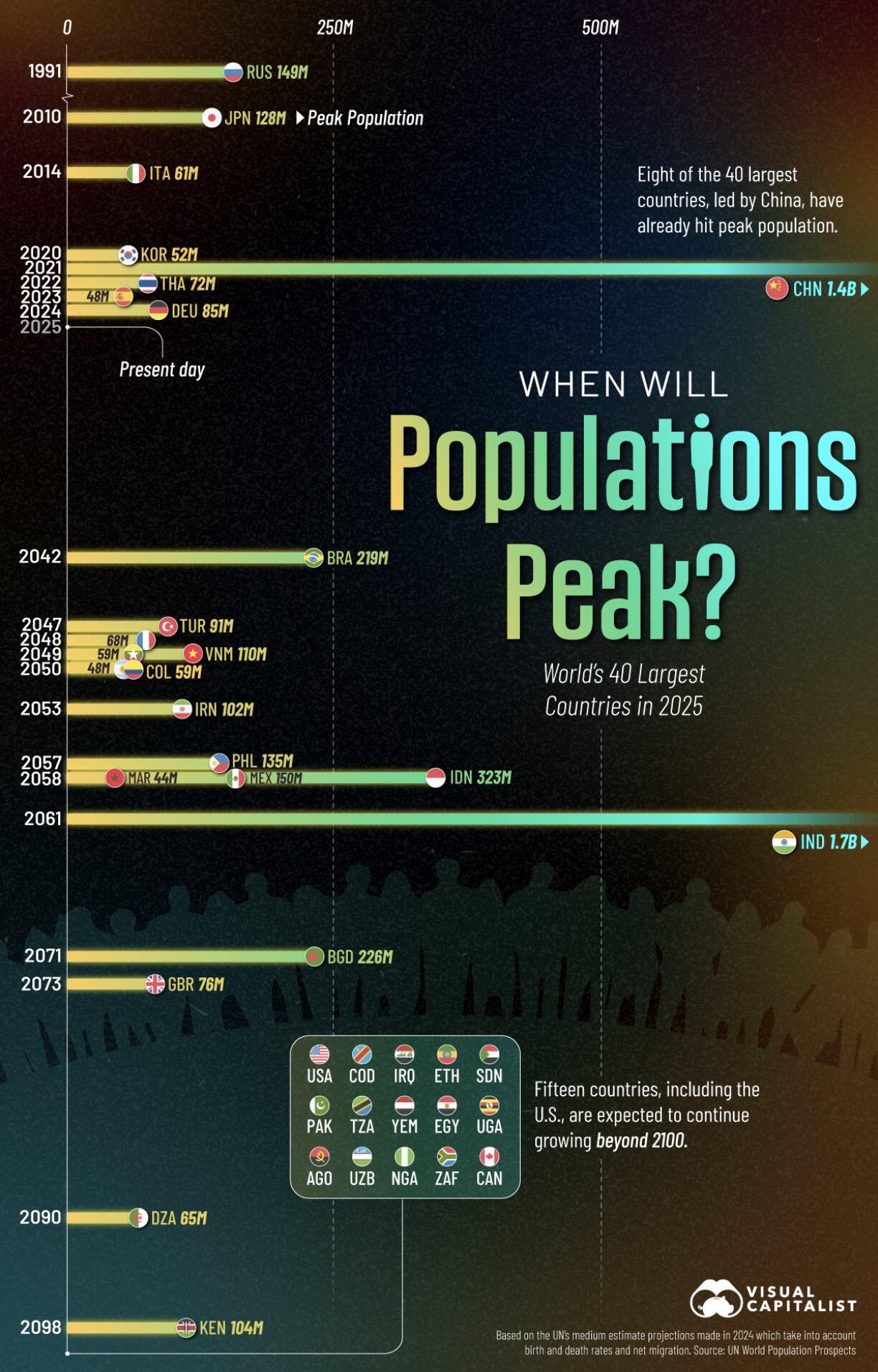
Some nations are shrinking, while others have decades of expansion ahead.
The infographic, via Visual Capitalist's Pallavi Rao, maps out when the 40 most-populous countries in 2025 will reach their population ceiling—and whether that ceiling is even within this century.
The data comes from the UN World Population Prospects (2024 revision), which projects population counts under its medium-fertility scenario.
Asia’s Early Population Peaks
China’s population crested at roughly 1.41 billion people in 2021 and is now drifting downward.
This decline will pick up pace over the next few years, changing the age structure in the country, raising alarm bells for the government.
| Rank | Most Populous Countries | 2025 Population | Peak Population Year | Peak Population |
|---|---|---|---|---|
| 1 | 🇮🇳 India | 1.5B | 2061 | 1.7B |
| 2 | 🇨🇳 China | 1.4B | 2021 | 1.4B |
| 3 | 🇺🇸 U.S. | 347.3M | No Peak This Century | N/A |
| 4 | 🇮🇩 Indonesia | 285.7M | 2058 | 0.3M |
| 5 | 🇵🇰 Pakistan | 255.2M | No Peak This Century | N/A |
| 6 | 🇳🇬 Nigeria | 237.5M | No Peak This Century | N/A |
| 7 | 🇧🇷 Brazil | 212.8M | 2042 | 219.3M |
| 8 | 🇧🇩 Bangladesh | 175.7M | 2071 | 226.1M |
| 9 | 🇷🇺 Russia | 144.0M | 1991 | 149.4M |
| 10 | 🇲🇽 Mexico | 131.9M | 2058 | 149.9M |
| 11 | 🇯🇵 Japan | 123.1M | 2010 | 128.2M |
| 12 | 🇵🇭 Philippines | 116.8M | 2057 | 135.2M |
| 13 | 🇪🇹 Ethiopia | 135.5M | No Peak This Century | N/A |
| 14 | 🇪🇬 Egypt | 118.4M | No Peak This Century | N/A |
| 15 | 🇨🇩 DRC | 112.8M | No Peak This Century | N/A |
| 16 | 🇻🇳 Vietnam | 101.6M | 2049 | 110.0M |
| 17 | 🇮🇷 Iran | 92.4M | 2053 | 102.0M |
| 18 | 🇹🇷 Türkiye | 87.7M | 2047 | 91.4M |
| 19 | 🇩🇪 Germany | 84.1M | 2024 | 84.6M |
| 20 | 🇹🇭 Thailand | 71.6M | 2022 | 71.7M |
| 21 | 🇬🇧 UK | 69.6M | 2073 | 76.1M |
| 22 | 🇫🇷 France | 66.7M | 2048 | 68.2M |
| 23 | 🇹🇿 Tanzania | 70.5M | No Peak This Century | N/A |
| 24 | 🇿🇦 South Africa | 64.7M | No Peak This Century | N/A |
| 25 | 🇮🇹 Italy | 59.1M | 2014 | 60.7M |
| 26 | 🇲🇲 Myanmar | 54.9M | 2049 | 58.6M |
| 27 | 🇰🇪 Kenya | 57.5M | 2098 | 104.2M |
| 28 | 🇨🇴 Colombia | 53.4M | 2050 | 59.4M |
| 29 | 🇰🇷 South Korea | 51.7M | 2020 | 51.9M |
| 30 | 🇸🇩 Sudan | 51.7M | No Peak This Century | N/A |
| 31 | 🇪🇸 Spain | 47.9M | 2023 | 47.9M |
| 32 | 🇺🇬 Uganda | 51.4M | No Peak This Century | N/A |
| 33 | 🇦🇷 Argentina | 45.9M | 2050 | 48.3M |
| 34 | 🇩🇿 Algeria | 47.4M | 2090 | 65.1M |
| 35 | 🇮🇶 Iraq | 47.0M | No Peak This Century | N/A |
| 36 | 🇾🇪 Yemen | 41.8M | No Peak This Century | N/A |
| 37 | 🇨🇦 Canada | 40.1M | No Peak This Century | N/A |
| 38 | 🇦🇴 Angola | 39.0M | No Peak This Century | N/A |
| 39 | 🇲🇦 Morocco | 38.4M | 2058 | 43.7M |
| 40 | 🇺🇿 Uzbekistan | 37.1M | No Peak This Century | N/A |
Meanwhile, Japan’s decline set in much earlier, peaking in 2010 and shrinking by more than five million residents since then.
South Korea reached its summit in 2020, while Thailand and Germany tipped over in the early 2020s.
Rapid urbanization, high education costs, and entrenched low fertility explain much of the region’s demographic slowdown.
America’s Outlier Trajectory
The U.S. is one of only three top-10 countries with no population peak forecast before 2100.
UN demographers see its population climbing past 420 million by 2100, buoyed by inward migration that offsets sub-replacement fertility.
By contrast, fellow rich-world nations like Italy and Spain have already peaked, and France is projected to crest before 2050.
Sub-Saharan Africa’s Century of Growth
Nigeria, Ethiopia, Tanzania, and the Democratic Republic of Congo are all projected to keep growing past 2100.
High birth rates, younger age structures, and improving child-survival rates mean these countries could more than double their populations over the next 75 years.
In fact, Nigeria and the DRC are both expected to surpass the U.S. in total people before the century’s end.
Why Population Peaks and Declines Matter
Knowing when populations peak helps policymakers anticipate economic shifts
Shrinking workforces strain pension systems and slow GDP growth, while surging populations raise demand for education, jobs, housing, and infrastructure.
The demographic map is therefore a leading indicator of where future consumption, labor, and geopolitical influence will concentrate.
No comments:
Post a Comment